
Yoga and Hiking in Morocco: How to Choose Between the Sahara and Atlas
Desert yoga retreat in Morocco · Yoga retreat in the Atlas Mountains
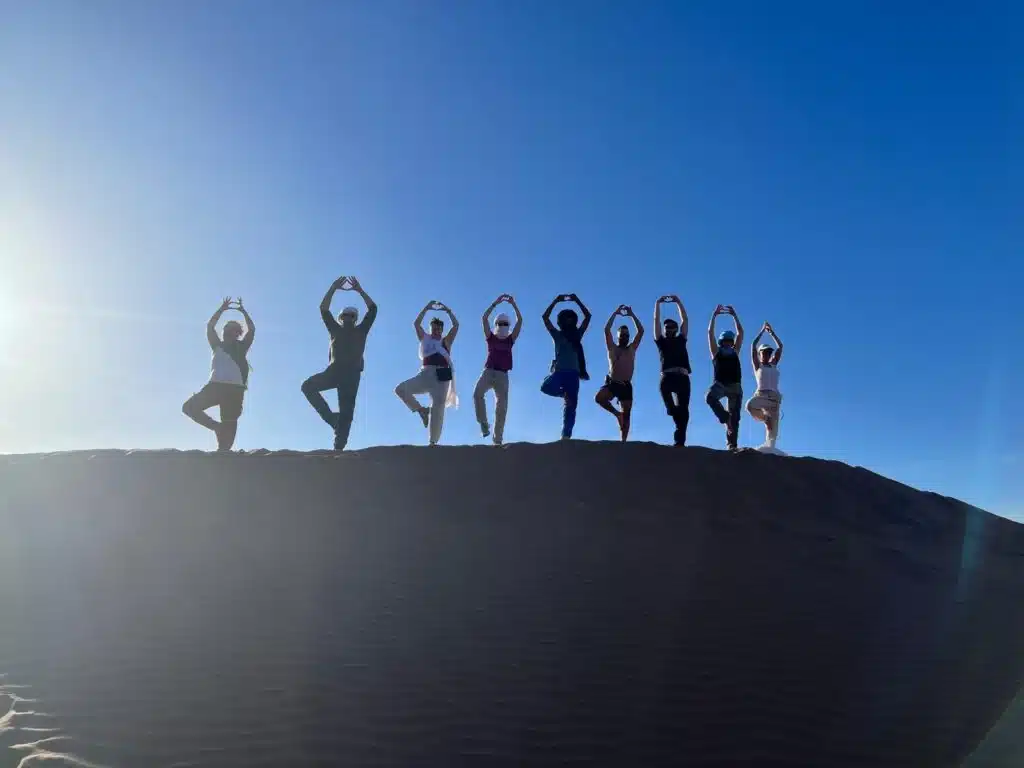
Yoga and hiking in Morocco work best when the route, teaching and recovery time are planned together. Choose between the High Atlas and the Sahara according to terrain, accommodation, season and group experience.
- Confirm the walking level separately from the yoga level.
- Compare mountain paths with desert terrain and mobile camps.
- Plan time for actual rest, meals and transfers.
- Check the teacher and local guide’s separate roles.
- Confirm sleeping kit, yoga mats and included services.
The first surprise on a walking holiday in Morocco is how quickly the landscape changes when you leave the road. In the High Atlas, a path may pass between terraced fields, stone houses and slopes that rise steeply above a village. In the Sahara beyond M’Hamid, a seemingly empty horizon becomes a sequence of stony plains, tamarisk patches and changing dunes. Both settings invite movement, but they ask different things of the traveller.
Adding yoga to that journey can be worthwhile. Not because a sunrise posture guarantees a life-changing revelation, but because a well-planned practice gives people time to pay attention to how they are moving and to recover between activities. A yoga and hiking holiday in Morocco is most satisfying when neither activity is an afterthought. The route needs enough interest to justify the walking, while the schedule must leave energy, space and suitable conditions for yoga.
Why combine hiking with yoga in Morocco?
Walking gives a destination texture. You notice how a village meets its surrounding fields, how a trail crosses a streambed, or how the sand changes underfoot on the way to a desert camp. You cannot collect the same details from a vehicle window. The pace naturally creates opportunities to ask questions, listen to the guide and understand why a route takes the line it does.
Yoga adds another kind of attention. Depending on the teacher and group, it may involve gentle movement, breathing, balance or a quiet period on the mat. It can be a welcome contrast after carrying a daypack or negotiating uneven ground. That does not mean a yoga session is a treatment for injury or a substitute for rest, food and water. The useful combination is simpler: make walking meaningful, make practice purposeful and allow time for both.
The difference between an active retreat and an overloaded itinerary
Many itineraries sound attractive when every hour is listed: early yoga, breakfast, a long hike, a cultural visit, sunset meditation and an evening workshop. On the ground, this can leave very little time for washing, eating slowly, changing clothes or simply sitting quietly. If the purpose of the holiday is to step out of a hurried routine, a full timetable can work against it.
A sensible design begins with the main activity for each day. If the group is hiking for several hours, an easier session later may be more appropriate than a vigorous sequence. If an instructor wants a substantial morning and afternoon class, the walking can be shorter or optional. Neither arrangement is wrong. What matters is that the participants know what they are signing up for, and that the guide and yoga teacher agree on the rhythm.
The Sahara experience: walking from M’Hamid with a local team
M’Hamid El Ghizlane is a practical gateway for desert trekking in southern Morocco. Routes from here may follow firm ground, sandy stretches and areas of dunes. Erg Zahar, Erg Smar and Erg Chigaga represent different parts of the region and require different amounts of travel. A short retreat should not imply that all three can be visited as if they were adjacent stops.
For a moving retreat, the group walks with a local guide while dromedaries may transport the main luggage, kitchen and bivouac equipment. The smaller items needed during the stage remain in a daypack. The camp moves with the route, and yoga sessions are planned around the conditions. A stay based at one camp is another possibility for teachers who want more time for longer classes. These two styles of travel should be described separately, particularly when comparing prices.
The Atlas experience: walking in valleys, not necessarily climbing peaks
The High Atlas offers a different atmosphere. A route may lead through villages and cultivated valleys, with overnights in guesthouses or other accommodation agreed for the programme. Azzaden and the wider mountain foothills can offer the framework for less demanding walking days, although even a valley path may include slopes, steps and uneven surfaces. A high-level traverse is a separate type of undertaking.
You do not have to climb Mount Toubkal to enjoy a yoga and hiking holiday in the Atlas. In fact, combining a significant summit objective with long daily yoga sessions may be a poor match for a mixed-ability group. If teaching and rest are priorities, it can be better to stay in one village and take walks from there. In other itineraries, the group moves between lodgings; mules may carry luggage where the route permits.
A possible day on a yoga-and-walking retreat
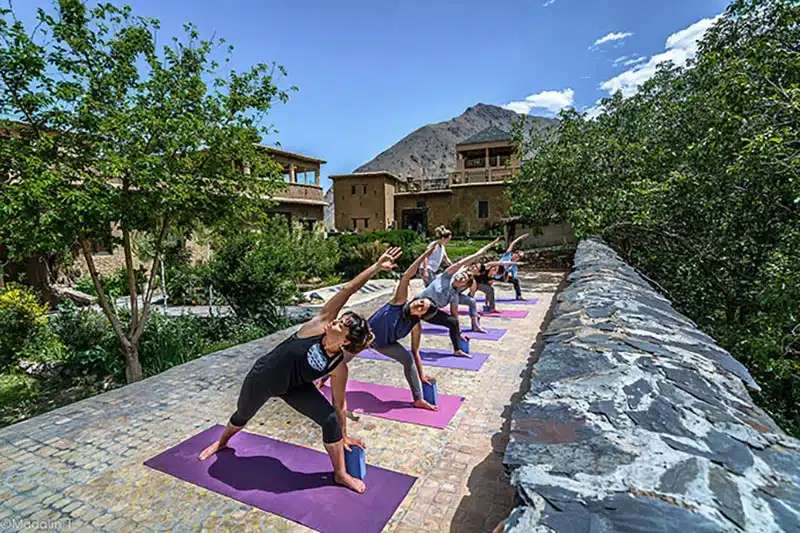
Imagine a spring morning in a mountain village. The teacher leads a short, accessible practice in a space checked for privacy, firm flooring and enough room for each participant. Breakfast follows, then the hiking guide takes the group onto a path through the valley. There is time to stop, learn about the area and move at a pace suitable for the people present, rather than rushing to reach a photograph.
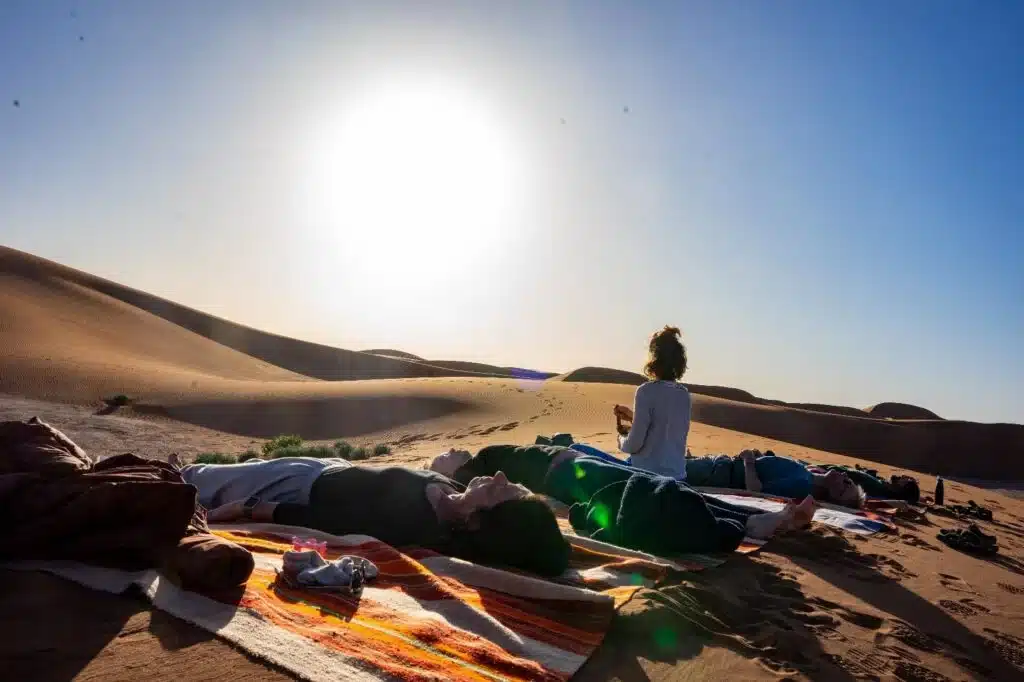
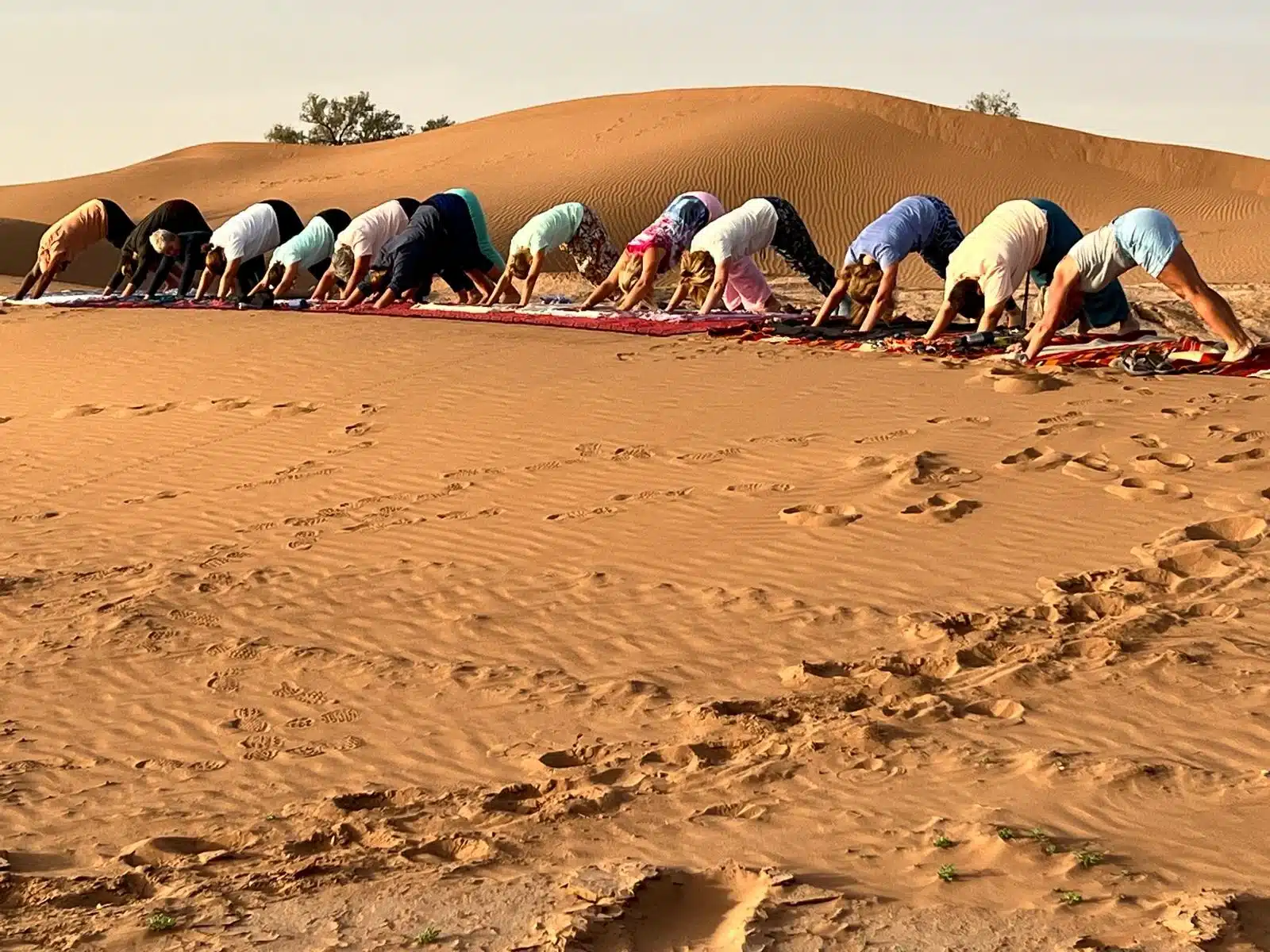
In the desert, the picture is different. The team may choose a sheltered flat area for an early session, rather than a steep and windswept dune. The walking stage follows, with rests according to the conditions. At camp, participants need time to settle, eat and prepare for the night. A later practice might be very gentle or it might not be scheduled at all. These are illustrations, not guaranteed schedules: weather and actual terrain always have a say.
Choosing the right walking difficulty
The word “easy” can be misleading. Two hours on soft sand, three hours on a rocky trail and four hours along a gentle valley path are not identical experiences. A useful itinerary describes the approximate walking time, ascent or descent where relevant, terrain, luggage arrangements and planned breaks. Travellers can then judge whether it suits their experience.
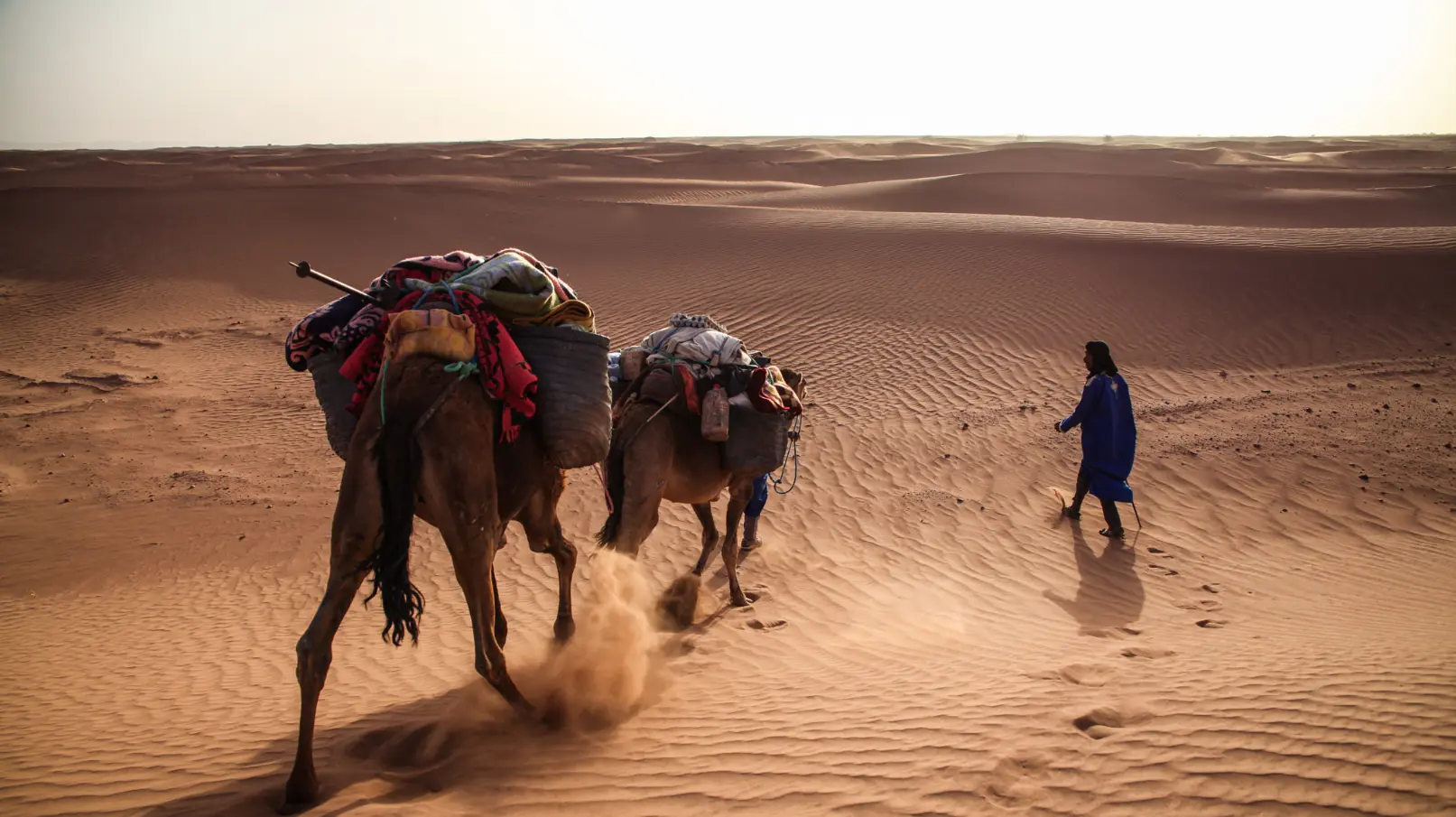
On a gentle desert programme, walking stages of around two to four hours may be possible, while some softer Atlas valley routes can be planned around three to four hours. More demanding journeys are longer and may involve significant climbs. None of these ranges should be presented as a universal promise. A guide can adjust the pace for conditions, but an appropriate route needs to be chosen before the group arrives.
Do you need yoga experience to take part?
Yoga and hiking ability are different considerations. An experienced hillwalker may never have taken a yoga class; a regular yoga practitioner may find descending a rough slope uncomfortable. A retreat can welcome beginners when the teacher has planned suitable options and the walk matches the participants’ capabilities. The brochure should state both levels separately.
Ask about the style and language of the teaching, whether optional sessions are available, and what happens if a participant wants to miss a practice. Someone with a health condition that affects exercise should discuss appropriate activity with their healthcare professional. A well-designed retreat does not depend on pushing past pain, making unrealistic therapeutic claims or treating every participant as identical.
Which yoga styles work alongside hiking?
There is no single best form of yoga for a hiking trip. Hatha, Yin, restorative practices and more flowing styles can all be relevant, depending on the instructor and the timing. The question is how the session responds to the physical work already done. A long sequence of demanding poses may be unwelcome after a difficult mountain descent. An accessible mobility session, on the other hand, may sit naturally alongside a gentler walking day.

Conditions matter as much as style. A mountain terrace needs enough space and a suitable surface. A desert practice area should be checked for wind exposure, slope, loose sand and shade. Bring or arrange mats and accessories according to the programme, rather than assuming camping equipment includes yoga props. Teachers organising their own group should describe specific requirements before choosing the camp.
When should you travel: desert seasons versus mountain seasons
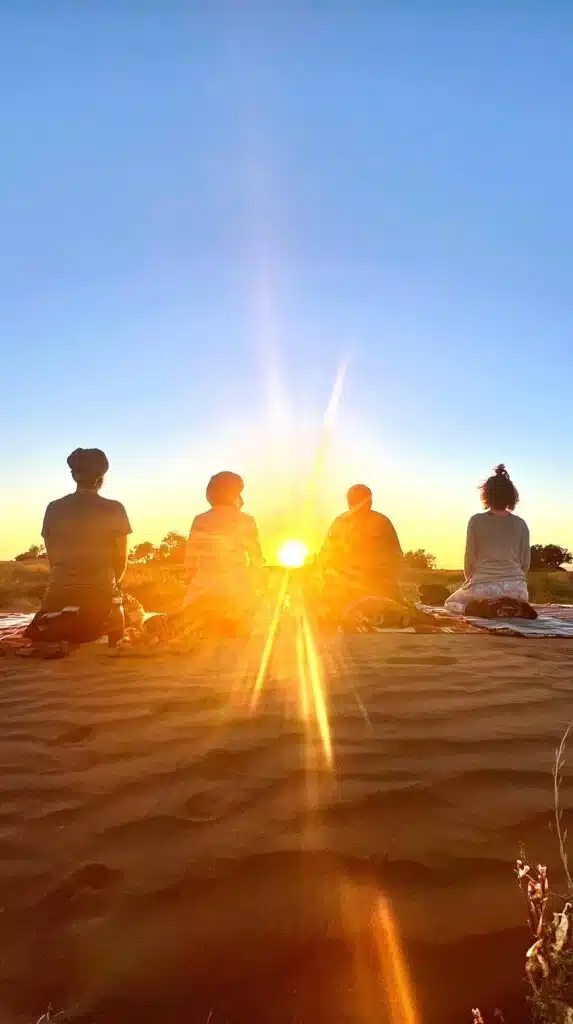
For the Sahara, autumn and spring are common starting points for planning walking retreats. October, November, March and April often provide more manageable daytime conditions than midsummer, although wind and colder nights can still affect the programme. Winter can be suitable for walking but needs warm layers, especially when participants remain still during an early practice. High summer heat makes extended outdoor activity unsuitable for many groups.
The Atlas needs its own seasonal assessment. Altitude, exposure and location change the conditions significantly: lower valleys can be warm, while higher routes may retain winter snow or require special equipment. A retreat near a village does not face the same logistical demands as a high-altitude traverse. Dates should be matched to a specific route with local knowledge, not chosen solely because a generic search says Morocco has good weather.
Where will you sleep, and what does the accommodation include?
Accommodation can determine whether participants genuinely enjoy a retreat. In the Sahara, a mobile bivouac is simple. It does not have built-in toilets or washing facilities. A programme based at one camp might offer other arrangements, but these should be documented rather than assumed. Confirm sleeping equipment, privacy arrangements, the availability of water and any facilities that matter to your group.

In the Atlas, a village guesthouse, mountain refuge and tent have different levels of comfort and access. Consider whether your group needs a place to change, an indoor practice alternative, a private area or special arrangements for meals. Dietary requirements and allergies should be communicated in advance. The clearest quote describes accommodation and services night by night, instead of using a broad phrase such as “comfortable camping”.
Travel logistics: the hours before the walking begins
International travellers often arrive in Marrakech, but Morocco’s trekking areas are not all close to the airport. The journey from Marrakech to M’Hamid takes most of a day by road. Building that transfer into the schedule prevents the first yoga class from becoming a race after a long drive. Depending on the programme, a departure from Ouarzazate or Agadir can also be considered.

The Atlas involves a different transfer pattern, depending on the chosen valley or trailhead. Confirm the collection point, start time, what the transfers cover and where the trip ends. If your booking starts at the trailhead rather than at the airport, you need to know that before buying flights. Travel insurance and any medical support requirements also deserve attention for remote walking routes.
How a yoga teacher should design a group trip
For a teacher bringing students, the first document should be a teaching outline, not a list of famous attractions. Identify your dates, group size, preferred practices, session lengths, dietary arrangements, walking experience and privacy requirements. A camp that works for a small circle might not have a sufficiently sheltered space for twenty mats. Some programmes can include a local teacher; others are built around the instructor who travels with the group.
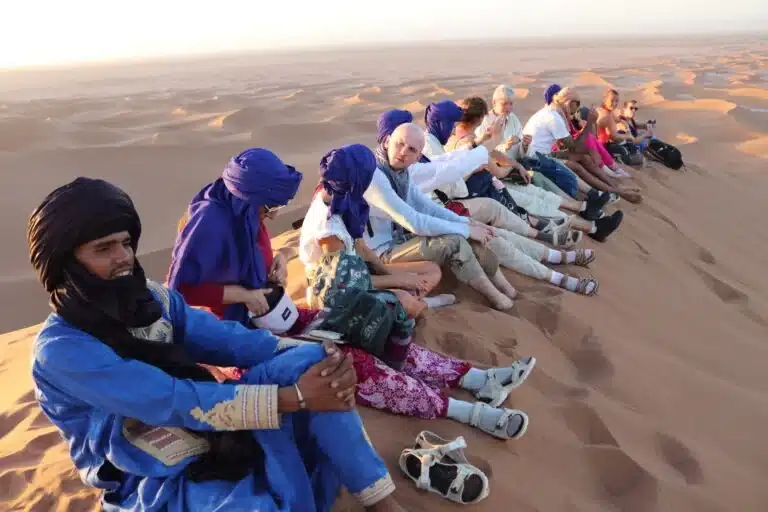
The local trekking team then assesses routes, transfers, camp capacity, equipment and safe walking times. The teacher remains responsible for leading yoga and adapting the sessions. The guide remains responsible for navigating and making decisions about the terrain. Good coordination makes the experience less stressful for both parties. It is also the most convincing answer when a prospective traveller asks what the retreat price really includes.
How to compare yoga and hiking holiday prices
Do not compare two offers by their headline price alone. One may include airport transfers, several guesthouse nights and the yoga teacher’s services; another may begin at the desert trailhead with instruction arranged separately. Ask exactly how many nights are included, which meals and drinks are provided, how luggage moves, who leads walks and how the yoga programme is delivered.
Also check group size, single-room or single-tent arrangements, equipment, transport, booking conditions and optional costs. Flights and insurance may be outside the package. A transparent proposal should state this clearly. A lower price is not necessarily a better choice if it changes the type of accommodation or leaves essential logistics for participants to arrange at the last minute.
Questions before choosing yoga and hiking in Morocco
Can I choose an easy route?
Is a desert camp as comfortable as a hotel?
Will I need to bring a yoga mat?
Can we visit the Sahara and Atlas in one trip?
Will I hike every day?
Let the journey determine the right balance
The strongest yoga-and-hiking holidays in Morocco are specific about what happens. They do not promise identical sessions in every landscape, or sell a desert camp as a luxury hotel. They describe the path, explain the practicalities and reserve time for the group to settle into the place.
Trek Desert Maroc works with local teams to organise desert and mountain walking programmes, including yoga retreats shaped around the teacher and participants. Explore our guide to preparing a Morocco desert yoga retreat and contact our team with your preferred dates, group size and priorities. We can then help identify whether the Sahara, the Atlas or a carefully paced combination is the right setting.