

Morocco Desert Trek Packing List: What to Bring to M’Hamid
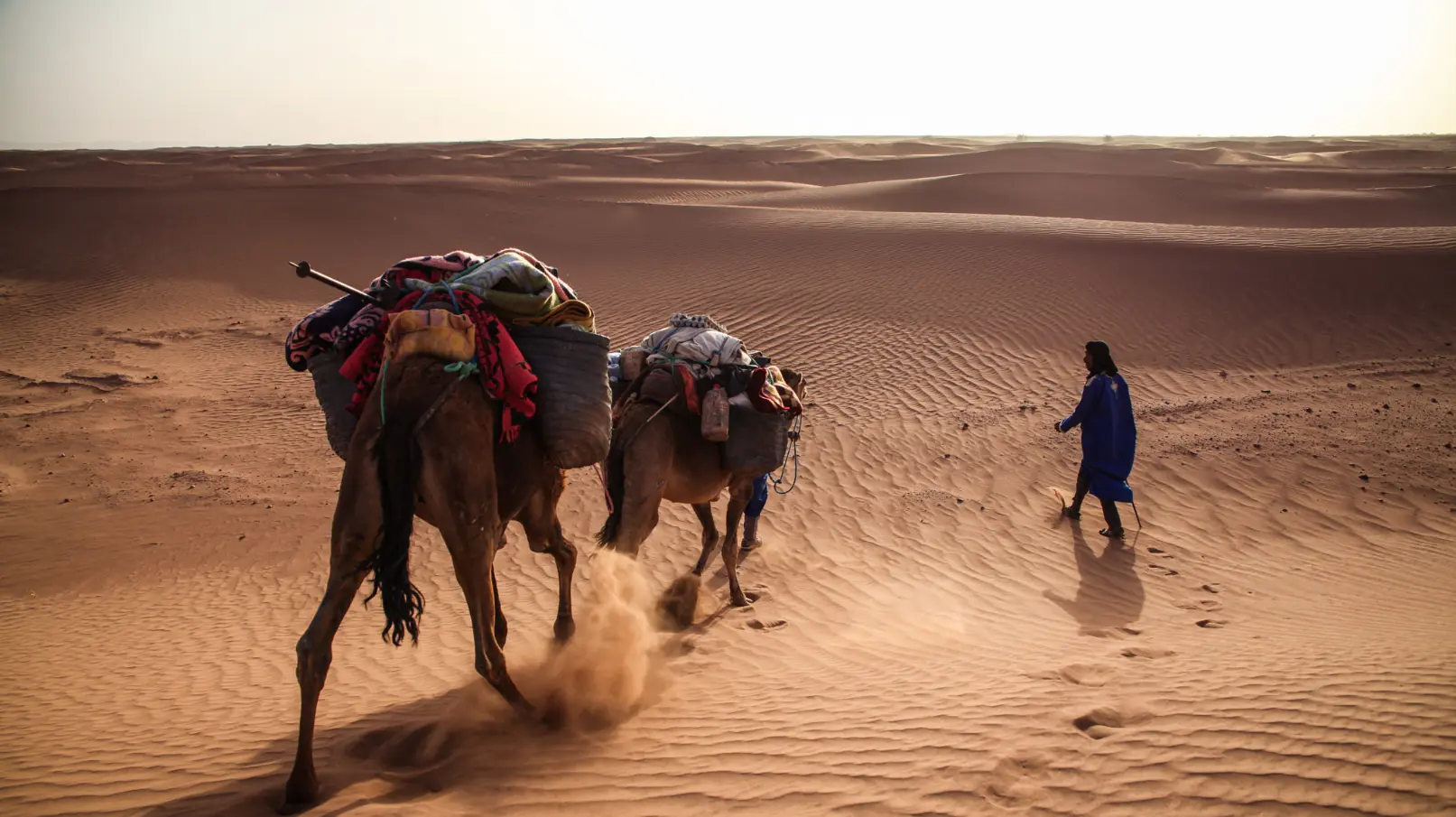
Bring tested walking footwear, comfortable sun-covering clothes, warm evening layers, sunglasses, sunscreen, a hat or turban, a headlamp and personal essentials. You carry a daypack; the camels carry your main bag. Tents, mattresses and sleeping bags are supplied.
- Pack for two jobs: walking-day access and overnight luggage.
- Choose footwear for stony ground as well as dunes.
- Evening warmth matters even when daytime walking feels warm.
- Sleeping equipment is supplied, with no single-tent supplement.
- Mobile camps have no toilet or washing installations.
Packing becomes much easier once you know which bag you will actually carry. On our walking treks from M’Hamid, the camels take your main luggage, camp equipment and kitchen. You walk with a daypack. That means a useful Sahara packing list begins with access: what must stay with you between camps, what belongs with the caravan, and what the team already provides.
The setting matters too. A route towards Erg Zahar, Erg Smar or Erg Chigaga may link palm-fringed ground, open stony plains, tamarisk and sand before reaching a broad dune landscape. Shoes and clothing need to work through that changing ground. This guide is for a supported walking journey in the M’Hamid–Foum Zguid desert region, rather than an overnight road excursion or a self-supported expedition.
Check the supplied kit before buying anything
Our desert team includes a guide, camel handlers and a cook. The baggage camels carry the main personal bags as well as camp and kitchen equipment. We provide tents, mattresses and sleeping bags. Sleeping arrangements are available for solo travellers and couples, and there is no extra charge for a single tent. You do not need to buy a complete camping setup just to join a supported trek.
All meals, tea and drinking water are included throughout the confirmed programme, including its planned transfer days. Tell us about dietary requirements before departure, so the cook can prepare supplies. Bringing your own familiar snack is a personal choice, not a substitute for telling us about an allergy or food requirement. Soft drinks and alcohol are separate from the included drinks.
If you prefer your own sleeping bag, discuss it with us before packing it. The same applies to a particular bedding requirement or an item that is unusually bulky. A caravan carries equipment through a landscape; it is not an invitation to bring unlimited luggage. Ask for the appropriate bag size and weight for your departure. Any extra suitcase for a longer holiday in Morocco needs a separate arrangement before the walking section begins.
Build a daypack you can use without unpacking it
Keep your water containers, sun protection, sunglasses and a useful extra layer where you can reach them. Add the personal items you need during the stage, your phone or camera, and a small rubbish bag. Documents and valuables should remain under your control. Evening clothes, spare underwear and toiletries can travel in the main bag rather than riding on your shoulders all day.
Fit matters more than a particular number of litres. Try the pack with filled water containers and the clothing you will wear. Walk for long enough to notice whether a strap rubs your neck or whether the load pulls backwards. Check that you can reach a bottle without emptying everything onto the ground. A pack that feels tidy in a bedroom may behave differently during several hours of walking.
Do this separation each morning before the caravan is loaded. Main luggage will be available at camp, but it should not be treated as a cupboard you can open at every pause. Keep anything essential for the stage with you. That small habit makes rest stops easier: you can take a drink, put on a layer or protect a camera without asking the team to unpack a load.
Use a soft main bag and a repeatable packing system
A soft-sided bag is generally easier to organise with caravan luggage than a large hard suitcase. Use a few internal pouches: one for clean clothes, one for evening layers and one for toiletries. Close everything properly and identify the outside of your bag. Sand and fine dust can work into poorly protected items; a zip is not a guarantee of a dustproof seal.
Put the clothes you will want first at camp near the opening. When you finish walking, it is useful to find your warm layer before deciding where every smaller item belongs. Keep footwear separate from bedding and clean clothes. A bag for used clothing helps you manage several nights without spreading its contents around the campsite.
Packing light does not mean leaving out what you genuinely need. It means avoiding three objects that serve the same purpose. Look at each item and decide when you will use it. If the only answer is a very unlikely scenario already covered by the team's arrangements, ask us whether it belongs in your bag. Reduce the extras before removing practical warm clothing or personal essentials.
Choose footwear for the ground between the dunes
Bring walking shoes or boots that you have already used comfortably on longer walks. Desert routes include firm and stony sections as well as sand, so choose footwear that protects your feet and suits your walking habits. A heavy new boot is not automatically better than a familiar, well-fitting walking shoe. Equally, a loose city sandal may feel very different once the ground becomes rough.
Test your shoes with the socks you intend to bring. Notice heel movement, toe space and any rubbing. Carry spare socks and your usual foot-comfort items. If you feel a problem starting during the trek, tell the guide early. Stopping to adjust a sock or empty sand is part of looking after a walking day, not an interruption that must be postponed until camp.
Light camp footwear can be welcome in the evening. It is an extra for resting, rather than a promise that the entire trek can be walked in sandals or barefoot. Gaiters may help some walkers manage sand, but their usefulness depends on the shoe and the person. Try them before travelling if you intend to use them. The aim is a comfortable system, not the longest equipment list.
Pack separate solutions for sunshine and still evenings
For walking, choose clothing that lets you move freely and provides the coverage you want. Comfortable trousers and a lightweight long-sleeved top make a practical starting point. Bring sunglasses, sunscreen and a hat or turban. Make sure the head covering stays comfortable with your backpack and does not get in the way of looking down at uneven ground.
At camp, the calculation changes because you are no longer producing the same warmth through walking. Keep a dry evening outfit and bring layers that work together: for example, a fleece, a warmer jacket suited to the departure period, and protection against wind. Winter departures need particular attention to the evening kit. Ask us to review your layers for your dates instead of assuming that the word Sahara means warm nights.
Our desert trekking season runs from mid-September to mid-May. That is a long span, with different daytime and overnight conditions. The season guide helps you choose when to travel; the final packing advice should use the actual dates and route. Put a warm layer where you can reach it when you arrive at camp. The time spent resting, eating and talking outside deserves as much thought as the hours spent walking.
Make sleeping arrangements simple and personal

Sleeping equipment is supplied; an outdoor night depends on the evening conditions.
Because the sleeping equipment is supplied, your personal night kit can stay compact. Bring comfortable sleeping clothes and a working headlamp. Keep glasses, phone and anything you may need after dark in a pouch you can locate without searching through the whole bag. Test the headlamp before departure and bring the power or batteries it needs.
Sleeping under the stars is possible when temperature and conditions allow. The tent remains available; choosing a desert trek does not mean committing to sleep outside every night. Decide with the team according to the evening's conditions and your own comfort. A photograph of a starry sky is an illustration of the setting, not a weather forecast.
Read the overnight plan carefully. A fixed camp may be used at the beginning or end, depending on the itinerary; some programmes mainly allow a final stop for a shower and rest. Mobile trekking camps do not have toilets or washing installations. Knowing this before booking is more useful than packing a large wash bag and expecting a bathroom to appear each evening.
Prepare for water access and simple camp hygiene
Drinking water is included. Bring containers that you can use comfortably and ask the guide how the day's supply will be organised. The amount to carry in your daypack depends on the stage and conditions. A generic internet figure cannot replace the morning briefing for your actual walk. Fill the containers and check access before the main bags are loaded.
Keep toiletries small and practical for nights without bathroom facilities. Bring the personal hygiene products you need, together with sealable bags for taking waste out. Used wipes and sanitary products must not be left in the sand. A biodegradable label does not make a wipe suitable to discard at camp. Follow the team's guidance for protecting campsites and water places.
Keep necessary personal medicines accessible during the day, with relevant instructions. Let us know in advance about a need that changes the walking or camp arrangements. Specific medical questions belong with your healthcare professional before travel; a general packing guide cannot decide your treatment. Share the operational information the team needs rather than waiting until the first mobile night.
Plan electronics around several nights away from sockets
A charged power bank and a tested cable can be more useful than several spare devices. Do not plan a mobile trek around charging from a wall socket every evening. Keep the headlamp separate from your phone so that taking photographs, communicating and finding something in the tent do not all depend on one battery.
Protect camera equipment from dust and avoid opening bags on exposed sand when the wind is blowing. Choose the kit you can carry and use comfortably. A heavy lens adds little if you avoid taking it out for the whole stage. Leave room in your attention for the walk itself: the changes between stony ground, tamarisk and dune slopes are part of the journey, not just gaps between photographs.
Have travel documents, insurance details and useful contacts available in an organised place, with offline copies if you normally use your phone. Tell people at home that reception and charging may not be available at every stage. Agreeing that expectation beforehand is more helpful than promising an update each evening and relying on an uncertain connection.
Adjust the list to your route and the people walking
Longer treks usually need better organisation of clothes and personal consumables, rather than a completely different outfit for every day. Choose layers you can combine and a workable system for clean and used clothing. If you are comparing two-to-four-hour walking days with six-to-seven-hour stages, test your loaded daypack and footwear on longer walks before choosing the more demanding route.
For children, familiar clothing and a hat they will actually wear are particularly useful. Keep a warm layer easy to find and make any child's daypack appropriate to their ability. Camel support is organised with the family according to the route and needs; it does not automatically mean a dedicated riding camel for each child. Explain their walking experience when planning the trek.
Before closing your bag, put each item into one of three groups: worn, carried during the day, or carried by the caravan. Remove duplicates, test the lamp and shoes, and ask us the remaining questions about your departure. The purpose of packing is to make the walking and camp routine easier. You should be able to arrive in a new landscape, find your evening things and settle in without sorting through half a holiday's luggage.
A final packing check
| Item | Keep with you on the walk | Main bag / team provision |
|---|---|---|
| Water and sun protection | Water containers, glasses, sunscreen, hat or turban | The team organises the included drinking water |
| Clothing | An accessible layer for stops | Spare clothes and warm evening layers |
| Footwear | Tested walking shoes or boots | Optional light camp footwear |
| Sleeping equipment | — | Tent, mattress and sleeping bag supplied |
| Personal essentials | Documents, valuables and items needed during the stage | Compact toiletries and sleeping clothes |
| Lighting and electronics | Protected phone or camera | Headlamp and its power supply, easy to find at camp |
Useful references
Further background: REI’s general hiking-clothing guidance and Leave No Trace’s waste guidance. The support arrangements described here are those of Trek Désert Maroc.
Get the packing right for your route
Tell us your dates, walking plans and equipment questions. We will help you match the bag to the stages and camp nights you are considering.
Plan my trek