

M’Hamid Desert Trek: 4 or 5 Days to Erg Zahar?

Choose four days for two main walking stages, two mobile camp nights and a 4×4 return from Erg Zahar. Choose five days to continue through Erg Bourabara and walk back towards M’Hamid: there are four walking stages, including the final stage before the road transfer. Both programmes begin with a night at a fixed camp.
- Four days include two main walking stages, rather than four full hiking days.
- The shorter trip returns mainly by 4×4 from Erg Zahar after a short walk to the vehicle.
- Five days continue through Erg Bourabara and include four walking stages, with the final stage before the road transfer.
- Both start with one fixed-camp night, followed by either two or three mobile nights.
- Baggage support is included; riding requests, camp requirements and transfers need to match your agreed programme.
Start with walking time, rather than the number in the title
Four days in a travel programme do not necessarily mean four full days on foot. Getting to M’Hamid, meeting the desert team and returning to your onward destination all occupy time. On our shorter Erg Zahar itinerary, the two main walking stages fall on days two and three. On the longer itinerary, walking runs from day two to day five, with the last stage sharing the day with the road transfer.
That distinction is useful if you are fitting the Sahara into a wider Morocco holiday. Someone who wants a first experience of a moving camp may be happy with two walking days. Someone who wants walking to become the daily routine may find the continuation beyond Erg Zahar more rewarding. Neither choice requires pretending that arrival and departure days disappear from the calendar.
Both journeys are walking treks supported by a baggage caravan. They are different from a road tour with a camp night or a short camel ride. The camels carry the main bags and camp equipment; riding is a separate request. Make that distinction early, especially if one person in your party is expecting to walk while another imagines spending the whole journey on a camel.
The comparison: two main stages or a longer walking circuit
The table below describes these two Trek Désert Maroc programmes, rather than every four- or five-day trip sold from M’Hamid. The shorter itinerary contains three nights in total: one at the fixed camp and two in mobile camps. The five-day version has four nights: the same opening fixed-camp night followed by three mobile nights.
The route after Erg Zahar is just as important as the extra night. With four days, a short walk connects you to the vehicle and the main return to M’Hamid is by 4×4. With five days, the walking continues through the Erg Bourabara area before returning towards the village. It is not simply another evening at the same dune camp.
Read the transfer arrangements alongside these facts. A plan starting in Marrakech cannot be assumed to have the same road day as one starting in Ouarzazate or Agadir. If you already expect to be in M’Hamid, discuss a local meeting point and how the first night fits. Do not remove a day yourself and assume the remaining camp and transport arrangements stay unchanged.
| Compare | 4 days | 5 days |
|---|---|---|
| Total nights | 3 | 4 |
| Fixed-camp night | 1 | 1 |
| Mobile nights | 2 | 3 |
| Walking stages | 2 main stages + short return connection | 4, including the last stage before transfer |
| After Erg Zahar | Main return by 4×4 | Continue towards Erg Bourabara |
| Back towards M’Hamid | 4×4 after a short walk | On foot via Lbour and the Draa |
What the four-day trek feels like on the ground
The first day brings you to the fixed camp near M’Hamid under the agreed transfer arrangements. It is the time to meet the team, separate the day bag from the baggage carried by the caravan and settle into the practical rhythm of camp. Any sightseeing on the road belongs to the confirmed itinerary; travelling from a different city does not automatically include the same stops.
Day two leaves the familiar edges of the settlement for the landscapes of the Draa and the route towards Sidi Naji. Palm trees, tamarisk and open ground provide a changing introduction to the desert. Walking allows those transitions to register: the move away from cultivated edges matters as much as the later dune view. The first mobile night is planned in the Sidi Naji area.
The following stage reaches Erg Zahar, crossing firmer surfaces and softer sand. Once camp is established, exploring nearby dunes depends on the weather, the group and the time available. The fourth day includes a short connection on foot before the 4×4 return and onward road journey. This is a compact introduction to caravan-supported walking, with two nights that travel with the route rather than a single camp used for the whole stay.
Why a fifth day changes more than the trip length
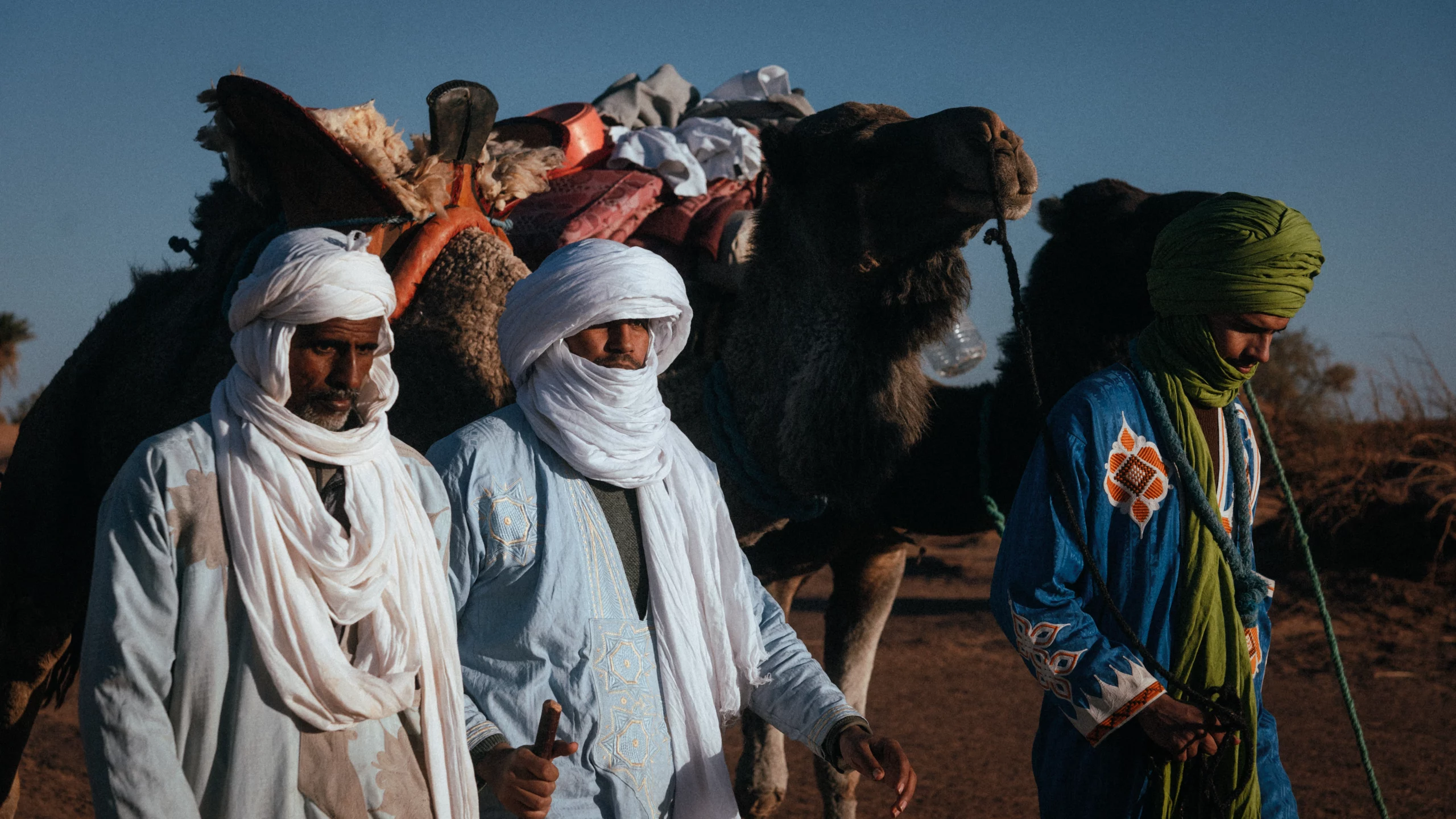
The five-day route begins with the fixed-camp night and follows the approach through Ras Nkhal towards Sidi Naji on day two. It gives you time to establish a walking rhythm before the Erg Zahar stage on day three. The baggage moves with the caravan while you carry the essentials needed during the day.
The distinctive part comes after the dunes. Day four continues through the Lhdibate and Etonr sectors towards Erg Bourabara. Sand, firmer desert ground and scattered trees keep changing the character of the walk. Lunch and overnight positions are selected by the guide with local conditions in mind, rather than treated as unchanging points regardless of wind or the state of the ground.
On day five, the route turns towards Lbour, the Draa and M’Hamid, before the agreed road transfer. You gain another mobile night and a more continuous walking journey. You also need to be comfortable with consecutive stages and an early start when the final walk and road journey must work together. The longer option is best understood as an extension of the walking experience, not a promise of a slower final travel day.
The desert between the photographs
An Erg Zahar picture usually shows the destination: high sand shapes and their changing light. The approach includes other landscapes. The palm-grove edge, tamarisk areas, stony or firm ground known as reg, and the traces of the Draa all form part of the trek. They help explain why the same distance can feel different from one stretch to the next.
On firmer ground, a steady pace can become comfortable. In loose sand, shorter steps and a different rhythm may make more sense. Your guide chooses the line and adjusts the pauses around conditions and the party. Shade is not continuous, and a useful break may simply be a practical place to stop rather than a named attraction.
Erg Zahar should also be kept distinct from Erg Chegaga. These are different dune destinations and our two comparison itineraries go to Erg Zahar. The four-day programme is not a four-day Chegaga trek. If Chegaga is the reason you are travelling, compare an itinerary designed for that destination instead. Choosing the right route is more useful than selecting whichever desert photograph looks most dramatic.
How demanding are the walking stages?
The four-day trek lists its main stages at roughly three and a half to four hours on foot. For the five-day programme, the main stages are generally around four to six hours, with the final stage arranged around the transfer. Treat these as planning estimates. Heat, wind, soft ground and the walking pace of the group all affect the effort and elapsed time.
Previous desert experience is not the only useful measure of suitability. Think about recent walks, how you manage several hours outside and whether you are comfortable sleeping with simple camp arrangements. For five days, consider how you feel when walking on successive days. Adding a night does not automatically make the same effort easier; this route also contains more walking.
Tell us about the walking you actually do rather than choosing a broad fitness label. For children, include ages, recent experience and the kind of breaks they normally need. If someone hopes to ride, discuss that separately before booking. A baggage camel is not an included riding arrangement and should not be treated as a guaranteed substitute for every stage of the walking programme.
Fixed camp and mobile camp are different experiences
The fixed camp near M’Hamid provides the first overnight stop on both itineraries. You arrive before the main trek, meet the people supporting the journey and prepare the bags. During the walking days, the camp moves with the caravan. The evening setting follows the route and the guide’s choice of a suitable overnight place.
The short trip includes two mobile nights; the longer trip includes three. That extra night means another evening living with the travelling camp. It does not imply an upgraded room or a more elaborate set of facilities. Sleeping outside can be possible when conditions allow, while tent arrangements remain part of the camp organisation. A clear sky should never be read as something included in the booking.
Ask what bedding is supplied, whether you need your own sleeping bag, how tents are allocated and what facilities are available at the fixed camp. Discuss any individual-room or sanitation requirements early. Photos of dunes, a tea stop or a baggage caravan illustrate the journey; they do not establish the equipment or comfort level of your particular overnight stay.
Carrying your bag and preparing for camp life
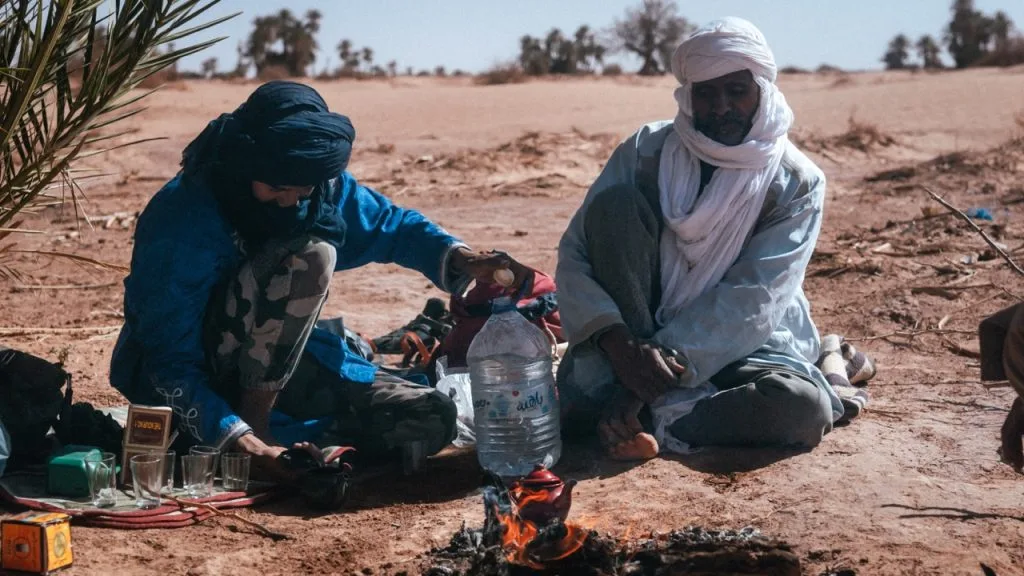
The baggage camels carry the main luggage and camp equipment. Your day bag stays with you, holding the water you need on the walk, sun protection, suitable layers and personal essentials. Ask about baggage limits and the preferred shape of your main bag. A manageable soft bag is easier to discuss with the team than arriving with equipment chosen for a different kind of trip.
Bring walking footwear you have already used, clothing that protects you from the sun, a hat and suitable evening layers. A head torch is useful around camp. The sleeping setup should match both the season and the bedding supplied by the operator, so settle that question before packing. Do not plan around the charging, washing or shopping opportunities of an urban hotel.
The published programmes include the local team, camp logistics and meals during the trek as specified in the itinerary. Explain dietary needs in advance. When comparing quotations, look separately at meals on transfer days, drinks, travel insurance and optional extras. Services during walking days should not be assumed to describe every meal or stop on the road from your chosen starting city.
Make the road journey fit the walking holiday
Marrakech, Ouarzazate and Agadir are possible agreed transfer origins, but they produce different journeys. A stop such as Aït Ben Haddou belongs to the plan only when included in the actual route and proposal. It is not an automatic extra attached to every city of departure. Compare the starting and finishing points before comparing prices.
The return needs the same attention. On the four-day trip it combines a short walk, the 4×4 connection and the road transfer. On the five-day trip the final walking stage comes before the drive. For a return to Marrakech or Agadir, keep a sensible margin before onward travel rather than building an evening flight around an assumed finishing time.
If you are already travelling in the south, joining in M’Hamid may be possible by agreement. Ask how that affects the meeting point, first night and quotation. A local start is a different arrangement, not permission to reinterpret the published programme without discussing it. The best short trek still needs enough time on either side for arrival, preparation and the journey that follows.
Choosing your route and asking for a useful quotation
Choose four days if your priority is to reach Sidi Naji and Erg Zahar on foot, try two mobile nights and use the vehicle return to keep the overall stay compact. Choose five if you want the walking to continue beyond Erg Zahar, see the Erg Bourabara sector and spend a longer sequence of days with the caravan. The answer depends on the journey you want, not which title sounds more ambitious.
The shorter itinerary advertises a September-to-May season, but conditions still vary within that period. Ask for advice for your proposed dates, including the evening clothing and sleeping setup. Neither an extra day nor a different start city removes the effects of wind, temperature and the condition of the sand. Avoid choosing on a promise of a particular sunset or a perfectly still night.
Send your dates, party size, starting city and intended finishing point. Add recent walking experience, children’s needs where relevant, dietary requirements and expectations for the nights. That gives us a practical basis for comparing both treks under the same assumptions. The detailed four- and five-day itineraries linked below are the next step: two routes to Erg Zahar, with a different amount of time given to the walk itself.
Plan your walking trip
Send your dates, party size and recent walking experience to compare both programmes.
Request a quotation