
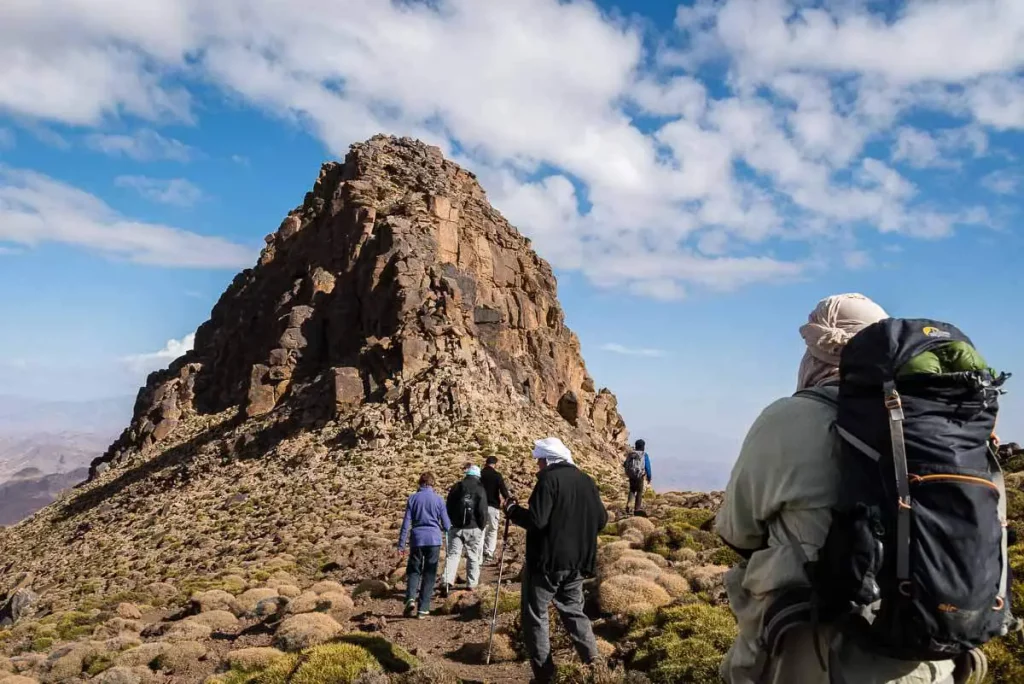
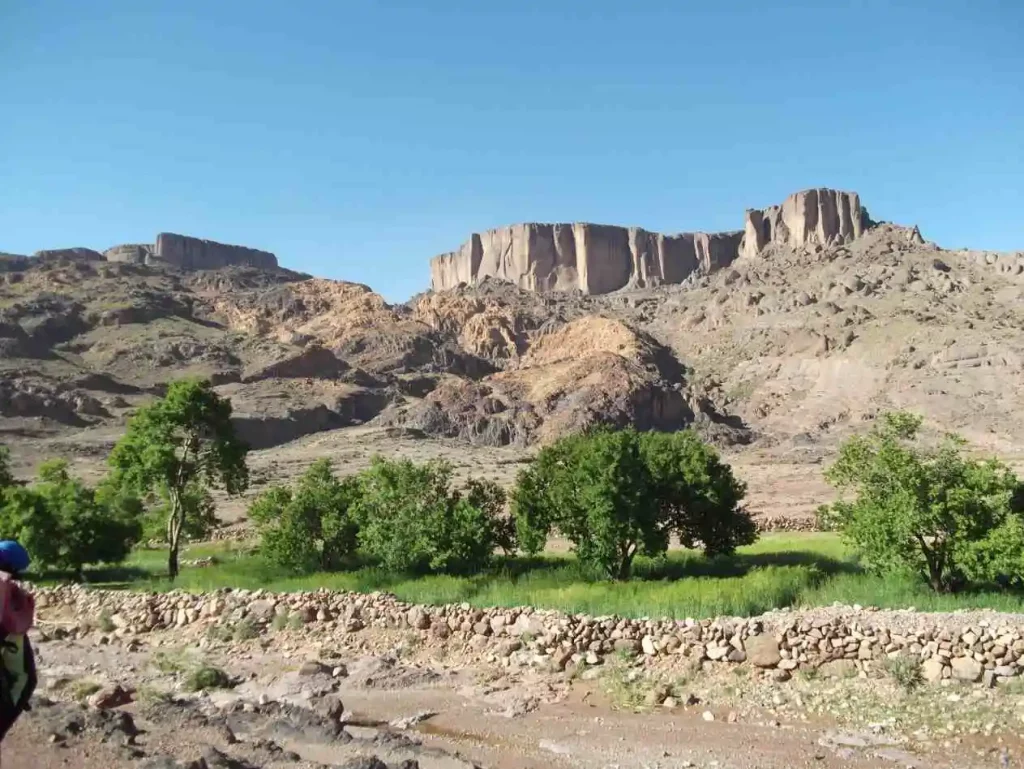
Jbel Saghro Trek: 6 Days through Bab n’Ali from Marrakech
Saghro offers a different journey from the villages around Imlil. Here the route follows open plateaux, rock formations and valleys where cultivated pockets stand out against stonier ground. The six-day programme begins with a road transfer from Marrakech to Tagdilt and ends with the drive back from the Handour side. Between those transfers are four walking stages, with a Kouaouck ascent, the Afourar valley and gorges, Bab n’Ali and the Ighazzoun oasis area. Three nights are under canvas; the first and last nights are in guesthouses. This is a mountain camping trek, not a Sahara dune tour with a camel ride.
The walk builds from the broad ground above Tagdilt towards higher viewpoints, then descends through Igli and Afourar before the rock towers at Bab n’Ali. The contrast is not only in the shapes of the mountains. A cultivated oasis or a place with almond trees feels different after hours across open terrain. The camps keep the route continuous, rather than bringing you back to a hotel each evening. We do not promise an active pastoral camp, a particular meeting with Aït Atta families or a tented cultural performance. People who use these landscapes follow their own seasonal routines. Any encounter should be respectful and unforced, with permission before taking portraits or entering private spaces.
The source estimates five to five and a half hours on each of the four main walking days. That is a sustained daily commitment, with climbs, long descents and exposed terrain. Kouaouck is listed around 2,600 metres; weather and the state of the trail still influence the route. The absence of a high Toubkal summit does not make the trek an easy stroll. Choose it if you enjoy regular hill walking and are willing to live simply for three nights in camp. Tell us about your recent hiking and camping experience so we can discuss suitability, equipment and the actual departure conditions.
Your guide leads the walking, while the cook and mule team support the agreed stages. Main luggage is carried where route and conditions allow, and you keep a daypack for water and personal essentials. Tent and mattress provision is part of the planned camping nights. The overnight sequence is Tagdilt guesthouse, plateau camp, Igli camp, Ighazzoun camp and Handour guesthouse. We confirm sleeping bags, tent sharing, guesthouse facilities, drinking water and guide language before booking. Do not assume private bathrooms, hot showers or an individual tent. The two long road days also need to be considered when fitting this trek into a wider Morocco trip.
A mountain crossing in Morocco’s dry south
Saghro offers a different journey from the villages around Imlil. Here the route follows open plateaux, rock formations and valleys where cultivated pockets stand out against stonier ground. The six-day programme begins with a road transfer from Marrakech to Tagdilt and ends with the drive back from the Handour side. Between those transfers are four walking stages, with a Kouaouck ascent, the Afourar valley and gorges, Bab n’Ali and the Ighazzoun oasis area. Three nights are under canvas; the first and last nights are in guesthouses. This is a mountain camping trek, not a Sahara dune tour with a camel ride.
Why the route works as a journey
The walk builds from the broad ground above Tagdilt towards higher viewpoints, then descends through Igli and Afourar before the rock towers at Bab n’Ali. The contrast is not only in the shapes of the mountains. A cultivated oasis or a place with almond trees feels different after hours across open terrain. The camps keep the route continuous, rather than bringing you back to a hotel each evening. We do not promise an active pastoral camp, a particular meeting with Aït Atta families or a tented cultural performance. People who use these landscapes follow their own seasonal routines. Any encounter should be respectful and unforced, with permission before taking portraits or entering private spaces.
What the walking and camping require
The source estimates five to five and a half hours on each of the four main walking days. That is a sustained daily commitment, with climbs, long descents and exposed terrain. Kouaouck is listed around 2,600 metres; weather and the state of the trail still influence the route. The absence of a high Toubkal summit does not make the trek an easy stroll. Choose it if you enjoy regular hill walking and are willing to live simply for three nights in camp. Tell us about your recent hiking and camping experience so we can discuss suitability, equipment and the actual departure conditions.
Supported camps, clear night-by-night arrangements
Your guide leads the walking, while the cook and mule team support the agreed stages. Main luggage is carried where route and conditions allow, and you keep a daypack for water and personal essentials. Tent and mattress provision is part of the planned camping nights. The overnight sequence is Tagdilt guesthouse, plateau camp, Igli camp, Ighazzoun camp and Handour guesthouse. We confirm sleeping bags, tent sharing, guesthouse facilities, drinking water and guide language before booking. Do not assume private bathrooms, hot showers or an individual tent. The two long road days also need to be considered when fitting this trek into a wider Morocco trip.
Day 1 — Marrakech to Tagdilt: cross the Atlas and reach the trailhead
Leave Marrakech early for the road over Tizi n’Tichka towards Ouarzazate. Continue towards the Dadès side before crossing more open country to Tagdilt, where the walking programme begins the following day. The journey introduces the change from the Atlas road to the dry southern mountain landscape. The source allows about six hours of road travel, subject to traffic, pickup and any agreed stops. Kasbah scenery along the route does not automatically include paid interior visits. Spend the first night in a guesthouse at Tagdilt, listed around 1,650 metres. Prepare your walking bag and camp kit rather than treating arrival as the start of another full hiking stage.
- Road transfer: approximately 6 hours
- Via Tizi n’Tichka, Ouarzazate and the Dadès side
- No main trekking stage scheduled
- Overnight: guesthouse in Tagdilt
Day 2 — Tagdilt to the high plateau: Iferd and the first camp
Meet the mule-supported trekking team and organise the main bags before setting out from Tagdilt. Cross broad plateau ground, then climb towards Tizi n’Iferd, around 2,400 metres in the source programme. Views towards the High Atlas depend on visibility; the pass itself is part of the route, not a guarantee of a clear panorama. Descend towards the plateau overnight area named N’Ouarg/Iferd in the programme, around 2,250 metres, with the precise campsite chosen for conditions. The first tent night introduces the practical rhythm of the trek: walking, a meal stop, arrival and settling into camp. Allow approximately five and a half hours of walking.
- Approximately 5½ hours walking
- Tizi n’Iferd: about 2,400 m in the source
- Plateau camp area: about 2,250 m
- Overnight: tent camp in the N’Ouarg/Iferd stage area
Day 3 — Kouaouck and the descent to Igli
Climb from the plateau towards Kouaouck, listed around 2,600 metres. This stage gives a higher view of the landscape you are crossing, with a picnic planned during the day. The usual dry-route programme treats it as a walking ascent, but conditions and the guide’s assessment determine the actual approach; it is not a promise that every date needs no extra precautions or equipment. Continue down via the Tassegdilt area to Igli, around 1,700 metres, for the second camp. The source estimates approximately five and a half hours for the complete stage. After the higher ground, the long descent remains a significant part of the day’s effort.
- Approximately 5½ hours walking
- Kouaouck: about 2,600 m in the source
- Descent via the Tassegdilt area
- Overnight: tent camp at Igli
Day 4 — Afourar gorges, Bab n’Ali and Ighazzoun
Follow the Afourar valley as it narrows into gorge country, with a planned stop around Bouallouz before continuing towards Ousdidene. Beyond the more enclosed valley, the landscape opens again towards the rock towers of Bab n’Ali. This shift from gorge to open ground makes the stage distinctive: the formations are reached within the walking journey, not as a roadside photograph stop. Continue to the Ighazzoun oasis area for the third tent night. Allow about five hours of walking according to the source, with the guide adapting details to terrain and conditions. The oasis setting does not guarantee a river crossing, swimming opportunity or a camp with hotel facilities.
- Approximately 5 hours walking
- Via Afourar, Bouallouz and the Bab n’Ali formations
- Continue towards Ighazzoun
- Overnight: tent camp in the Ighazzoun area
Day 5 — Tifdassine and the final walking stage to Handour
Leave Ighazzoun for the small Tifdassine pass and the valley beyond. The route descends through the landscape towards a lunch stop planned in an almond-growing area, then continues to Handour. Tree shade and vegetation depend on the place and season; neither blossom nor a fixed picnic table is promised. This is the fourth main walking day, estimated at around five hours. Spend the fifth and final night in a guesthouse. After three camp nights, the village stay changes the evening routine, but the actual rooms, bedding and washing facilities must still be confirmed rather than assumed to be hotel standard.
- Approximately 5 hours walking
- Via the Tifdassine pass and valley
- End of the four-stage walking traverse
- Overnight: guesthouse in Handour
Day 6 — Handour to Marrakech: a full road return
Say goodbye to the mule team and take the road or track connection towards Nkob, then continue via Agdz and Ouarzazate before recrossing Tizi n’Tichka towards Marrakech. A lunch stop is planned along the return programme. The source gives approximately seven hours for the transfer but also claims an early-afternoon arrival; those statements should not be combined into a guaranteed arrival time. Confirm departure, stops and drop-off before planning onward travel. There is no main walking stage, sixth overnight or included city sightseeing added to this day. Leave room for road conditions and the long crossing when arranging a flight or connection.
- Road transfer: approximately 7 hours in the source
- Via Nkob, Agdz, Ouarzazate and Tizi n’Tichka
- Arrival time and lunch-stop arrangements confirmed individually
- End: agreed Marrakech drop-off; no sixth overnight
Duration
6 days / 5 nights; 4 main walking days
Accommodation
2 guesthouse nights + 3 tent nights
Transport
Marrakech–Tagdilt outbound transfer; return via Nkob, Agdz and Ouarzazate
Who this trek suits
Hikers seeking rocky southern mountains and a supported camping trek
Season and route suitability
The existing programme is offered for September to May, with actual dates and conditions confirmed individually. That season statement does not guarantee a comfortable temperature or the same trail conditions every month. Prepare for open terrain and repeated walking days, and discuss previous hill walking and camp experience before booking. For families or anyone needing shorter stages, request an adapted plan rather than assuming this fixed traverse suits every age. Mountain-weather changes can require adjustments even in the dry south.
Equipment for three camp nights
Bring worn-in hiking boots, a daypack, a soft main bag, warm evening layers, wind and rain protection, a headtorch, sun protection and a sleeping bag suited to the confirmed season. Tents and mattresses are included for the planned camps; sleeping bags and any rental must be clarified separately. Keep water and personal essentials in the daypack. Confirm luggage carriage, camp sharing and any weather-related equipment before departure. Camping footwear can make evenings more practical, but it does not replace suitable boots for rocky stages.
Meals, water and facilities
The cook prepares trek meals within the agreed programme. Ask which meals on the two road days are covered, and disclose dietary needs or allergies in advance so practical options can be discussed. Drinks are excluded: confirm drinking-water supply, refills and any bottle costs. Camp toilets, washing arrangements and tent allocation must be explained before reservation; hotel-style bathrooms are not promised. The two guesthouse nights bookend the three camps, rather than replacing them with daily guesthouse stays.
Booking and onward plans
Send dates, party size, recent walking experience and language or room needs. The quotation confirms departure format, capacity, transfers and services; no unverified group minimum or maximum is advertised here. Flights, Marrakech hotel nights, personal insurance and discretionary tips are separate. The seven-hour return estimate calls for flexible onward planning. A request for availability is not a confirmed departure, and photos of a camp or viewpoint are not a guarantee of an exact pitch or the same weather.
Included
- Agreed Marrakech–Tagdilt and Handour–Marrakech road transfers
- Qualified trekking guide
- Cook and trek meals within the agreed programme
- Mule team and main luggage support where conditions allow
- Two guesthouse nights: Tagdilt and Handour
- Three tent nights: plateau stage, Igli and Ighazzoun
- Tents and mattresses for the three planned camps
Not included
- Flights
- Marrakech hotel nights and meals outside the agreed programme
- Drinks, bottled water and personal expenses
- Travel insurance and repatriation cover
- Discretionary tips for guide, mule team and driver
- Sleeping bag or other equipment hire unless included in writing
- Unconfirmed private visits, camel rides, city guides or paid monuments
Is this six days of walking?
No. Days two to five are the four main walking stages. Days one and six are long road transfers.
How many nights are in tents?
Three, between the guesthouse nights at Tagdilt and Handour. The camp sequence is the plateau area, Igli and Ighazzoun.
Does the route include Bab n’Ali?
Yes, on the fourth day, between the Afourar valley/gorge stage and the Ighazzoun area.
Is there a summit stage?
The third day includes a planned Kouaouck ascent, around 2,600 metres in the source, subject to route conditions and the guide’s assessment.
Is this a camel trek in Sahara dunes?
No. It is a mountain walking trek with mule support. No camel ride or dune-camp entitlement is included.
What fitness is needed?
Regular hill-walking fitness for consecutive five-to-five-and-a-half-hour stages on rocky ground, plus willingness to spend three nights in simple camps.
Are tents and sleeping bags included?
Tents and mattresses are provided for the planned camps. Sleeping bags, sharing arrangements and any hire must be confirmed separately.
Are drinking water and road-day meals covered?
Drinks are excluded. Confirm water arrangements and the precise meal coverage on transfer days in the proposal.
Will we visit a nomad family camp?
No particular family visit or encounter is guaranteed. Pastoral use of the region is context, not a contracted meeting.
Can I take a flight on the final evening?
The return drive is estimated at about seven hours with stops and variable conditions. Confirm timings and leave a substantial margin rather than relying on the source’s inconsistent early-arrival claim.
Description
Quick information
- Duration 6 days / 5 nights; 4 main walking days
- Location Jbel Saghro, southern Morocco — Tagdilt, Igli, Bab n’Ali and Handour
- Difficulty Moderate to sustained; regular hill-walking fitness required
- Departure format Private or small group by arrangement; dates and size confirmed
Plan your trek
More information
Call us
More treks
7-Day Family Desert Trek: M’Hamid to Erg Chegaga
- 7 days / 6 nights
- Moroccan Sahara — M’Hamid, Erg Chegaga and Erg Bougarn
- Moderate desert walking; suitability assessed for each family
6-Day Morocco Desert Trek: Erg Zahar & Erg Smar
- 6 days / 5 nights · 4 walking days
- M’Hamid · Sidi Naji · Erg Zmila · Erg Zahar · Erg Smar
- Moderate desert walking
4-Day Morocco Desert Trek from Marrakech: Erg Zahar
- 4 days / 3 nights · 2 main walking stages
- M’Hamid · Sidi Naji · Erg Zahar
- Easy to moderate; fitness assessment advised
7-Day Sahara Walking Holiday: The Desert Caravan
- 7 days / 6 nights · 5 main stages + return leg
- M’Hamid · Sidi Naji · Aït Ounir · Erg Zahar · Zmila · Lanhiche
- Intermediate desert walking