
4-Day M’Hamid Desert Trek to Erg Zahar
The dunes are only one part of this walk. Leaving M’Hamid, you first notice how the edge of the oasis gives way to tamarisk, open ground and sand. Near Erg Zahar, the dunes that looked distant become the landscape around you. Reaching them on foot lets you understand the spaces between the photographs.
We come from M’Hamid, and desert guiding is part of our family story. Our approach is to help you notice the route as well as complete it: where the ground changes, how a pack-camel team supports the camp, and why the pace needs to respond to the weather and the walkers.
This is a four-day, three-night programme with two principal walking stages. Days 2 and 3 involve approximately 3½–4 hours of walking each. You travel through the Sidi Naji area towards Erg Zahar, then return to M’Hamid by 4×4 on Day 4. It is a short introduction to a walking journey with a travelling bivouac, rather than four full days of hiking.
What makes this route worth walking
The route changes gradually: the oasis edge, scattered tamarisk, smaller dunes, firmer dry-lake ground and the larger dunes around Erg Zahar. Different surfaces ask different things of your feet. Your guide helps set a sustainable pace, leaving room to look around instead of treating the day as a race to camp.
Who will enjoy it
Choose this trek if you can walk for several hours and want to spend two nights in a nomadic bivouac without committing to a longer expedition. Sand can make a modest walking time feel demanding. If you need guaranteed hotel facilities each night, discuss your expectations with us before booking.
A small bag and a moving camp
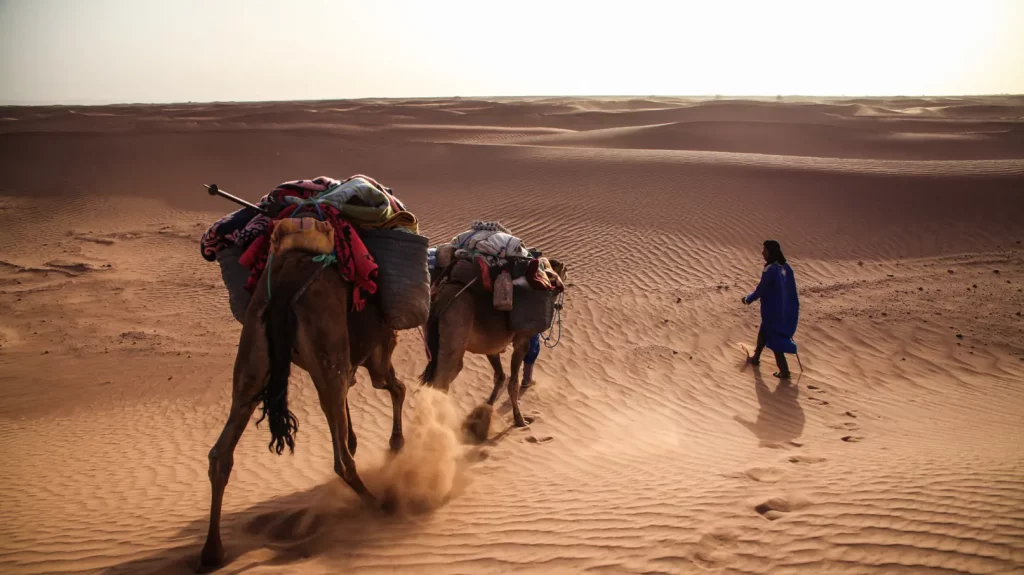
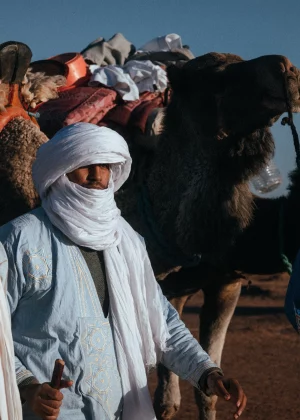
Pack dromedaries carry personal luggage and bivouac equipment. You walk with your daytime essentials. Camel riding is a separate request, not the defining activity of this journey. The first night is in a fixed camp near M’Hamid; the next two accompany your progress into the desert.
Highlights
- A gradual walk from the M’Hamid oasis edge to Erg Zahar.
- Two principal stages via Sidi Naji, approximately 3½–4 hours each.
- Pack-camel support for luggage and camp equipment.
- One fixed-camp night and two nomadic bivouac nights.
- Return from Erg Zahar to M’Hamid by 4×4.
Day 1 — Arrival in M’Hamid — change the pace before the walk
Your journey begins with the agreed road transfer towards M’Hamid. Arrival is a useful transition: the last inhabited landscapes of the Drâa region are still present, while the walking route ahead leads into increasingly open country.
Use this first evening to prepare your day bag and discuss the following stages with the team. The first night is in a comfortable fixed camp near M’Hamid. The main walking begins tomorrow; the transfer schedule is arranged for your chosen starting city.
- Arrival and preparation day; not a full walking stage.
- Night 1: fixed camp near M’Hamid.
- Pickup point and road-transfer timing confirmed in your booking proposal.
Day 2 — M’Hamid to Sidi Naji — watch the oasis recede
As you move away from M’Hamid, the vegetation thins and the view opens. The tamarisk and changing ground give the walk texture: you are not on the same stretch of dune all day. A distant feature becomes a useful marker of how far you have travelled.
The team sets the rhythm around conditions and the group. Sidi Naji also belongs to local oral tradition; ask your guide about the stories associated with this place. By evening, your first nomadic bivouac makes the journey feel different from a day excursion: you remain out on the route.
- Approximately 3½–4 hours of walking; pace and conditions can change this.
- Pack dromedaries carry the main luggage and camp equipment.
- Night 2: nomadic bivouac along the route.
Day 3 — Sidi Naji to Erg Zahar — the dunes draw closer
The second main stage brings a stronger contrast between smaller dunes and the flatter ground of a dry-lake area. Firmer sections and softer sand interrupt one another, so the day has its own rhythm.
Erg Zahar becomes more prominent as you approach. Walking lets you follow that change instead of passing straight to a viewpoint. The final desert night is in a nomadic bivouac in the Erg Zahar area; the precise pitch is chosen as part of the departure’s camp organisation.
- Approximately 3½–4 hours of walking.
- Mixed natural terrain, including sand and firmer ground.
- Night 3: nomadic bivouac in the Erg Zahar area.
Day 4 — Erg Zahar to M’Hamid — return by 4×4
The last morning is still spent in the desert landscape you have reached on foot. You do not retrace both walking stages: the planned 4×4 return brings you back towards M’Hamid.
The contrast is part of the journey. Distances you felt step by step now pass differently from the vehicle. The onward road transfer follows the arrangement confirmed for your booking; tell us about flights or fixed connections before choosing your departure.
- Return from the Erg Zahar area to M’Hamid by 4×4.
- No third full walking stage is advertised.
- Onward-transfer destination and arrival timing agreed before booking.
Duration
4 Days / 3 Nights
Accommodation
Desert bivouac nights form part of the route; the exact tent and comfort setup is confirmed in your proposal.
Transport
Walking on the main trekking days, with a 4×4 return from the Erg Zahar area to M’Hamid.
Who this trek suits
Travelers comfortable walking several hours on natural desert terrain; available as a private trek or a shared group departure.
Getting there and getting home
- Return transport from Marrakech, Ouarzazate or Agadir is included under the confirmed common trek terms.
- Agree your pickup address, departure time and final drop-off before booking. Road-transfer timing depends on the starting city; no single arrival time is promised for all departures.
Walking and fitness
- Two main walking days, approximately 3½–4 hours each.
- Easy-to-intermediate terrain still means walking on sand and uneven ground. Prepare with regular walks and wear footwear you have already used.
- Tell us about mobility limits or needs that could affect the route so we can discuss suitability.
Your three nights
- One comfortable fixed-camp night near M’Hamid and two nomadic bivouac nights.
- Confirm tent occupancy, bedding and sleeping arrangements in your proposal.
- Ask specifically about toilets, washing facilities and charging options; do not assume hotel facilities at a travelling bivouac.
Meals and drinking water
- Full board during the trek: breakfasts, lunches and dinners; tea and mineral water are included.
- Tell us about vegetarian preferences, allergies and other dietary requirements before booking. Confirm what the team can provide.
- Soft drinks and alcohol are excluded.
Luggage and pack camels
- Dromedaries carry personal luggage and camp equipment. You carry a small day bag.
- Keep your drinking water, sun protection and daytime layers accessible.
- Ask for the luggage format and permitted amount before packing. Camel riding must be requested separately.
Packing for changing conditions
- Bring worn-in walking footwear, sun protection, a hat, layers and a small day bag.
- Ask for the final seasonal packing list, including evening warmth and bedding requirements.
- Protect phones and cameras from sand; bring the power arrangement you need after confirming charging availability.
Weather and daily rhythm
- Weather affects walking time and camp organisation. Ask us about conditions for your actual departure month.
- A clear sky, a particular temperature or an exact campsite is not guaranteed. The team may adjust the rhythm to conditions.
Private journeys and shared departures
- Private departures are organised for your own party; shared departures depend on available dates and places.
- Contact us with your dates and number of walkers. A preferred date is not a confirmed group departure until we confirm it.
Respecting the route
- Carry personal rubbish back and follow the team’s advice around camp.
- Ask before photographing people and treat stories, homes and working animals with respect.
- Travel, assistance and repatriation insurance are required and excluded from the trek price.
Included
- Return transport from Marrakech, Ouarzazate or Agadir.
- Three nights in total: one night in a comfortable fixed camp at M’Hamid before the walking stages, and two nights in nomadic bivouacs.
- Full board throughout the trek: breakfasts, lunches and dinners.
- Tea and mineral water during this four-day trek.
Not included
- Soft drinks and alcohol.
- Travel insurance, assistance and repatriation cover (required).
- Tips for guides, cooks and camel handlers, at your discretion.
How many days are actually spent walking?
The programme is four days and three nights. Days 2 and 3 are the principal walking stages, each approximately 3½–4 hours. Day 1 is for arrival and preparation, and Day 4 returns by 4×4.
Do I need previous desert trekking experience?
Previous desert experience is not essential, but you should be comfortable walking for several hours on uneven ground. Sand takes more effort than a firm path. Discuss your fitness and expectations with us.
Does this trek reach Erg Chigaga?
No. This programme goes from M’Hamid through the Sidi Naji area to Erg Zahar. It is a different route from our Erg Chigaga treks.
Is the whole route through large dunes?
No. The appeal is the transition between oasis-edge landscapes, tamarisk, open desert, smaller dunes, dry-lake ground and Erg Zahar.
How many nights are included?
Three: one fixed-camp night near M’Hamid and two nomadic bivouac nights along the trek.
Are the road transfers included?
Return transport from Marrakech, Ouarzazate or Agadir is included under the confirmed trek terms. Agree the pickup point and onward destination in your proposal.
Who carries my luggage?
Pack dromedaries carry the main luggage and bivouac equipment. You walk with a small day bag. Ask us about luggage limits before packing.
Can I ride a camel instead of walking?
This is designed as a walking trek. Any riding request must be discussed separately; do not assume that riding is included or can replace every walking stage.
Are meals and water included?
Yes: full board during the trek, tea and mineral water. Soft drinks and alcohol are not included.
Can you cater for allergies or vegetarian meals?
Tell us your requirements before booking. We will confirm what can be arranged for the departure; do not leave allergies to be discussed only on arrival.
Will the bivouac have showers and electricity?
Facilities depend on the fixed camp and the travelling bivouac setup. Confirm toilets, washing, bedding and charging arrangements before booking. Hotel-style facilities are not promised for the nomadic nights.
Can I join a group on any date?
Shared departures depend on confirmed dates and available places. Send us your preferred dates; private departures are another option.
What is not included in the price?
Soft drinks and alcohol; required travel, assistance and repatriation insurance; and discretionary tips for the team. Any separate riding option needs its own agreement.
How should I request the right departure?
Send your dates, number of walkers, starting city and any fitness or dietary needs. We can then confirm the programme, transfers, camp arrangements and availability together.
Description
Quick information
- Duration 4 Days / 3 Nights
- Location M’Hamid El Ghizlane, Morocco
- Difficulty Easy to intermediate
- Departure format Private or shared group departure from M’Hamid
Plan your trek
More information
Call us
More treks
Trek Désert Maroc 5 Jours – Aventure Authentique au Sahara
- Sportif
- 5 jours - 4 nuits
- 4 à 12 personnes ou voyage privé.
Trek Désert Maroc 6 Jours | Randonnée et Aventure dans le Sahara
- intermédiaire
- 6 jours dont 4 jours après
- 4 à 12 personnes ou voyage privé.
Trek Désert Maroc 7 Jours : Voyage Dans Le Désert Marocain
- intermédiaire
- 7 Jours – 6 Nuits
- 4 à 12 personnes ou voyage privé.
Transhumance saharienne Maroc · Traversée du désert
- Intermédiaire à Sportif
- 21 Jours – 20 Nuits
- 4 à 12 personnes ou voyage privé.