

10-Day Saghro and Drâa Desert Trek
Description
This ten-day route links the rocky mountain paths of Jbel Saghro with the desert walking country of the lower Drâa. From Tagdilt, four main mountain stages reach Handour via the N’Ouarg plateau, Kouaouch, Igli and Bab n’Ali. A road transfer then takes you through Nkob and Zagora to the Nesrat sector, where a camel team replaces the mule team. Three main desert stages continue through Tidri and Erg Sahel to Ouled Driss. The first and last days connect the journey with Marrakech.
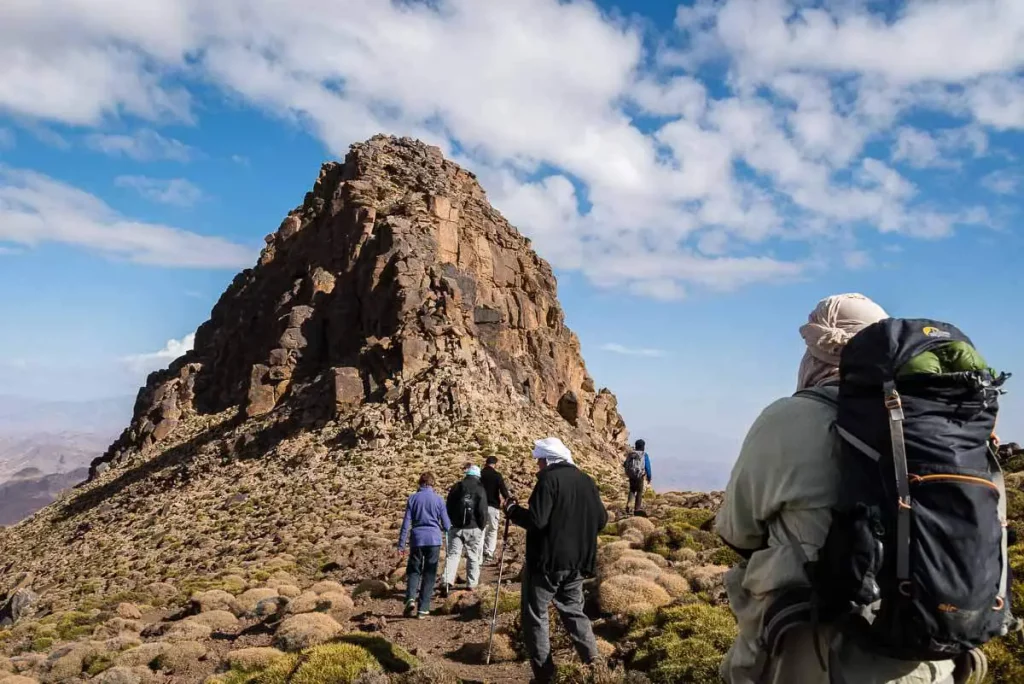
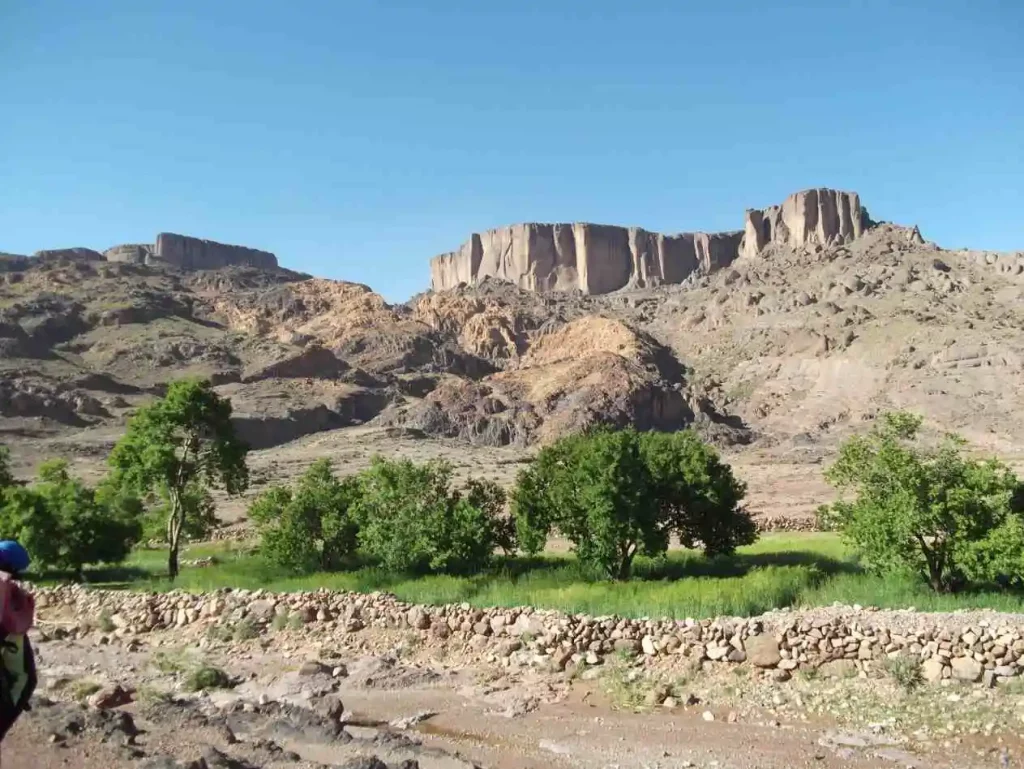
Saghro’s appeal is in its changing rock forms, cultivated pockets and the way paths link otherwise separated valleys. Kouaouch is a planned high-point objective around 2,600 metres, reached only if conditions and the group allow. The Afourar route and Bab n’Ali offer a different day of gorge and rock-tower scenery. Seasonal Aït Atta herding activity may be visible, but no private encounter is guaranteed. This is a sustained walking route, not a set of roadside viewpoints.
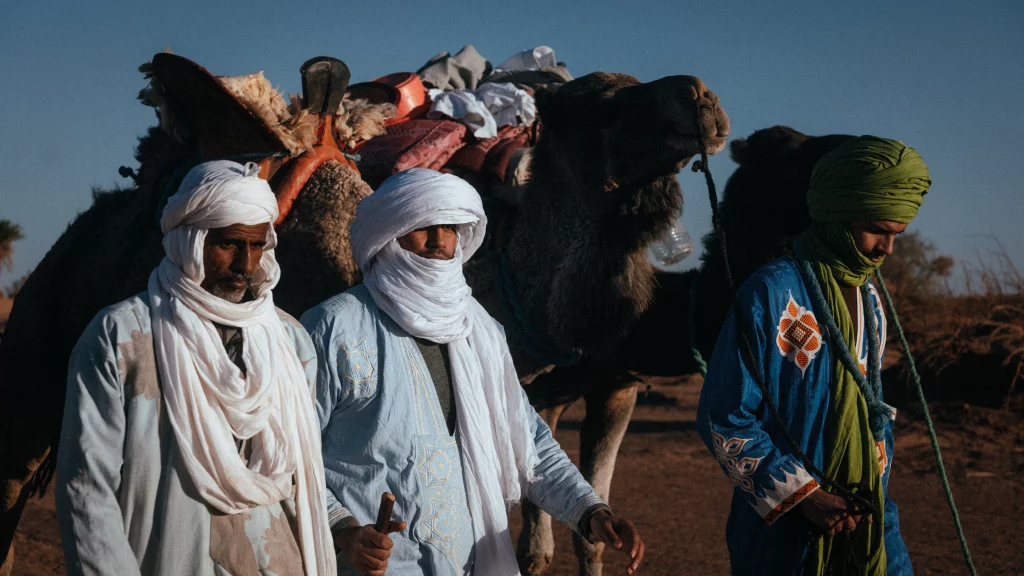
Beyond the transition to Nesrat, the landscape changes from mountain slopes to oasis edges, firm reg and dune walking. The itinerary passes the Tidri dunes and Erg Sahel before villages around Bonou, Ergabi and Ouled Driss bring earthen architecture back into view. It does not include Merzouga or Erg Chegaga. Camel support here concerns carrying the agreed trekking equipment and bags; a riding activity must be arranged separately if wanted.
The programme specifies two guesthouse nights, at Tagdilt and Handour, and seven tent nights. A qualified mountain guide, cook and mule/camel support are listed services. Meals run from lunch on day one to lunch on day ten. Tell us your dates, walking experience and starting arrangements so we can confirm accommodation, sleeping equipment, potable water and the commercial scope of all road legs. The last drive is long; an onward flight needs adequate margin.
One journey, with a deliberate change of landscape
This ten-day route links the rocky mountain paths of Jbel Saghro with the desert walking country of the lower Drâa. From Tagdilt, four main mountain stages reach Handour via the N’Ouarg plateau, Kouaouch, Igli and Bab n’Ali. A road transfer then takes you through Nkob and Zagora to the Nesrat sector, where a camel team replaces the mule team. Three main desert stages continue through Tidri and Erg Sahel to Ouled Driss. The first and last days connect the journey with Marrakech.
Why the mountain half deserves its own time
Saghro’s appeal is in its changing rock forms, cultivated pockets and the way paths link otherwise separated valleys. Kouaouch is a planned high-point objective around 2,600 metres, reached only if conditions and the group allow. The Afourar route and Bab n’Ali offer a different day of gorge and rock-tower scenery. Seasonal Aït Atta herding activity may be visible, but no private encounter is guaranteed. This is a sustained walking route, not a set of roadside viewpoints.
Then the caravan follows water and sand
Beyond the transition to Nesrat, the landscape changes from mountain slopes to oasis edges, firm reg and dune walking. The itinerary passes the Tidri dunes and Erg Sahel before villages around Bonou, Ergabi and Ouled Driss bring earthen architecture back into view. It does not include Merzouga or Erg Chegaga. Camel support here concerns carrying the agreed trekking equipment and bags; a riding activity must be arranged separately if wanted.
Nine nights and a clear support arrangement
The programme specifies two guesthouse nights, at Tagdilt and Handour, and seven tent nights. A qualified mountain guide, cook and mule/camel support are listed services. Meals run from lunch on day one to lunch on day ten. Tell us your dates, walking experience and starting arrangements so we can confirm accommodation, sleeping equipment, potable water and the commercial scope of all road legs. The last drive is long; an onward flight needs adequate margin.
Itinerary
Day 1 — Day 1 — Marrakech to Tagdilt: crossing into Saghro country
The road crosses Tizi n’Tichka and continues through Ouarzazate towards the Dadès region before the approach to Tagdilt. Cultivated valleys gradually give way to the drier mountain setting that will shape the next four days. The guesthouse night provides a place to meet the trekking team and sort the bags carried by the mules. The source allows roughly six hours driving before stops; sightseeing and the actual arrival time need agreement rather than a fixed evening promise.
- Around 6 hours driving, before stops
- Guesthouse: Tagdilt
Day 2 — Day 2 — Tizi n’Iferd and N’Ouarg: the first open plateau
The mule team loads the trekking equipment as the group starts across the plateau above Tagdilt. Height is gained towards Tizi n’Iferd, followed by a descent towards the N’Ouarg plateau. The openness of the terrain gives the first sense of Saghro’s scale, with distant High Atlas views when visibility permits. Camp is planned around 2,250 metres in the published route. Herding presence varies with the season; the team chooses the precise pitch for current conditions.
- About 5½ hours walking
- Tent camp: N’Ouarg plateau
Day 3 — Day 3 — Kouaouch to Igli: a high point, then a different valley
Kouaouch is the planned objective of the morning, around 2,600 metres in this itinerary. The source describes a walking ascent without technical equipment, but the guide must judge weather, terrain and group readiness before committing to the high point. The descent follows the Tassegdilt sector towards Igli, where camp sits in a different valley setting. The contrast between the open ridge and lower ground makes the day more than a summit attempt; the route itself remains the purpose if conditions require an alternative.
- About 5½ hours walking
- Tent camp: Igli
Day 4 — Day 4 — Afourar and Bab n’Ali: following the rock towers
The path descends along the Afourar valley into narrower gorge terrain, passing the Bouallouz sector before Ousdidene and the broad view towards Bab n’Ali. The rock towers become a landmark rather than an included rock-climbing activity. The team selects safe passage through the gorge for the actual conditions. Continuing towards Ighazzoun brings cultivated ground into the mountain story again. This stage rewards looking at how small pockets of water-supported land sit within the wider dry relief.
- About 5 hours walking
- Tent camp: Ighazzoun
Day 5 — Day 5 — Tifdassine to Handour: descending to a house night
The route leaves Ighazzoun towards the small Tifdassine pass, then follows a long descent in the valley of the same name. A lunch pause is planned along the way; the availability of shade and exact stop vary. Handour marks the end of the mountain walking section and the second guesthouse night. It is a useful break from tents before the desert begins, with washing, bedding and sharing arrangements to confirm rather than assumed private hotel facilities.
- About 5 hours walking
- Guesthouse: Handour
Day 6 — Day 6 — Handour to Nesrat: changing teams and terrain
The mule-supported mountain journey ends and the road takes over towards Nkob, the Drâa Valley and Zagora. Ksar and village landscapes replace the higher plateaux before the Nesrat sector and the meeting with the camel team. A shorter walking segment introduces the desert programme before camp. This is a mixed travel day, not another full mountain stage or a full-day camel ride. The transition is what makes the combined route practical without pretending the two walking areas are joined entirely on foot.
- Around 4½ hours driving + 2 hours walking
- Tent camp: Nesrat sector
Day 7 — Day 7 — Nesrat to Tidri: oasis paths become dunes
The desert stage follows the lower Drâa route through the villages named Ignaoun and Moulay Ali Achrif in the source, then the Zaouiat Sidi Salah sector. Oasis edges offer context for the relationship between water, settlement and caravan movement. The final approach reaches camp near Tidri’s dune setting. The published walking total is about five hours; its final hour and a half is only one part of the day, not the whole stage.
- About 5 hours walking
- Tent camp: Tidri
Day 8 — Day 8 — Tidri to Erg Sahel: sand, reg and open horizons
Sand walking around Tidri gives way to firm stony reg before the Erg Sahel sector. The difference underfoot is a large part of the day’s experience: a dune slope can take more effort than a broad, level stone plain. Camp allows an optional short stroll when the team and conditions permit. Sunset, a campfire or bread cooked in sand are not guaranteed activities; any fire or cooking demonstration must follow the team’s environmental and weather judgment.
- About 5 hours walking
- Tent camp: Erg Sahel
Day 9 — Day 9 — Ergabi to Ouled Driss: the villages return
The last main walking day passes desert ground near Bonou before the planned lunch area around Ergabi. Earthen houses bring a human scale back to the landscape, with village observation kept respectful and private interiors visited only by agreement. The route ends at Ouled Driss for the seventh tent night. It is not a hotel night added as an upgrade by default. The group can prepare bags for the road while taking stock of the change from Saghro rock to desert settlements.
- About 4½ hours walking
- Tent camp: Ouled Driss
Day 10 — Day 10 — Drâa Valley to Marrakech: leave time for the road
The vehicle follows the Drâa route north through Ouarzazate and over Tizi n’Tichka towards Marrakech. The source describes a long return of roughly 450 kilometres, with photo stops. The actual drive and pauses need confirmation; do not assume a quick afternoon arrival. Meals are specified through lunch today, while dinner and accommodation in Marrakech are outside this programme. Arrange the drop-off and onward travel with enough time for the mountain road.
- Long road return; timing to confirm
- No overnight included
Practical information
Duration
10 days / 9 nights
Accommodation
2 guesthouse nights + 7 tent nights
Transport
Marrakech–Tagdilt, Handour–Nesrat and Ouled Driss–Marrakech road legs
Who this trek suits
Experienced walkers seeking both mountain stages and a camel-supported desert route
Fitness and the two walking environments
Mountain stages are estimated at 5–5½ hours and desert stages at 4½–5 hours, excluding breaks. Day six adds two hours walking to around 4½ hours driving. Repeated days, uneven ground and sand require regular walking fitness. Confirm seasonal conditions and the guide’s route assessment; no universally easy or all-year claim is made.
Camp equipment, water and bags
Confirm tents, mattresses, sleeping bags, guesthouse bedding, sharing and washing facilities. Mule and camel support is for agreed equipment and main bags; carry a daypack. Potable-water provision needs explicit agreement because drinks are excluded in the published list. Do not treat wells or oasis water as automatically drinkable.
What the quotation must settle
The daily itinerary contains three essential road legs, but the source inclusion list does not explicitly price transport. Confirm vehicles, fuel, pickups and drop-offs in the quote. Meals are specified from day-one lunch to day-ten lunch. Agree diets, guide language, bag limits and any route-change arrangements before booking.
Requesting dates
The published format is 4–12 participants or a private trip. No live departure date or new price is assumed. Send group size, dates, walking experience, dietary needs and planned Marrakech connections. Ask for the exact houses and camp arrangements rather than treating archive photographs as a promise of a particular property.
Included / Not included
Included
- Two guesthouse nights: Tagdilt and Handour
- Seven tent nights across Saghro and the Drâa desert
- Meals from day-one lunch through day-ten lunch
- Qualified mountain guide and trekking cook
- Mule-team support in Saghro and camel-team support in the desert; bag limits to agree
Not included
- Flights and Marrakech accommodation/meals outside the programme
- Drinks and personal expenses; potable-water arrangements to confirm
- Travel/repatriation insurance
- Discretionary team tips
- Riding camels, private visits and equipment hire not explicitly agreed; road-transfer price scope to confirm
FAQ
How many main walking stages are there?
Seven: four in Saghro and three in the desert, plus a shorter walk on day six. Days one and ten are road days.
Does this route visit Chegaga or Merzouga?
No. The desert section follows Nesrat, Tidri, Erg Sahel, Ergabi and Ouled Driss.
Is Kouaouch guaranteed?
No. It is the planned high-point objective, subject to guide assessment and conditions. An alternative may be necessary.
How many nights are in tents?
Seven, with two guesthouse nights at Tagdilt and Handour. The total is nine nights.
Are camel rides included?
The listed camel service supports the desert caravan. Riding is not explicitly included and must be agreed separately.
Which meals are included?
The source specifies meals from lunch on day one through lunch on day ten. Marrakech meals outside that window are excluded.
Is drinking water included?
Drinks are excluded in the published list. Confirm potable-water supply and costs in the quote instead of assuming well water is suitable.
Are all transfers included in the price?
The itinerary requires three road legs, but the source commercial list is not explicit. Their full scope and inclusion must be confirmed.
Do we need technical climbing equipment?
The source describes the Kouaouch ascent as a walking route. The guide must check the full route’s terrain and any equipment requirements for your dates.
What should I send for a proposal?
Dates, number of walkers, experience, dietary needs, guide-language preference and arrival/departure plans.
Description
Quick information
- Duration 10 days / 9 nights
- Location Jbel Saghro and lower Drâa Valley, Morocco
- Difficulty Sustained mountain and desert trekking
- Departure format Group of 4–12 or private, on request
Plan your trek
More information
Call us
More treks
4-Day M’Hamid Desert Trek to Erg Zahar
- 4 Days / 3 Nights
- M’Hamid El Ghizlane, Morocco
- Easy to intermediate

8-Day Sahara Trek from Marrakech: Erg Zahar & Erg Chigaga
- 8 days / 7 nights
- M’Hamid · Erg Zahar · Erg Chigaga
- Sustained walking; level to confirm
7-Day Family Desert Trek: M’Hamid to Erg Chegaga
- 7 days / 6 nights
- Moroccan Sahara — M’Hamid, Erg Chegaga and Erg Bougarn
- Moderate desert walking; suitability assessed for each family
6-Day Morocco Desert Trek: Erg Zahar & Erg Smar
- 6 days / 5 nights · 4 walking days
- M’Hamid · Sidi Naji · Erg Zmila · Erg Zahar · Erg Smar
- Moderate desert walking