

Aït Bouguemez to M’Goun Gorges: 6-Day Trek from Marrakech
The six-day journey begins with the drive from Marrakech through Azilal to Aït Bouguemez. After a guesthouse night around Timit, the walking crosses Aït Imi and drops towards Ouzighimt. Village paths follow the river before the landscape narrows into the M’Goun gorges, where the route includes walking through water. The final stage reaches Boutaghrar and a second guesthouse night before the road return. Three nights between them are under canvas. This is a valley-and-gorge traverse, with four main walking days; it does not include an ascent of M’Goun’s high summit.
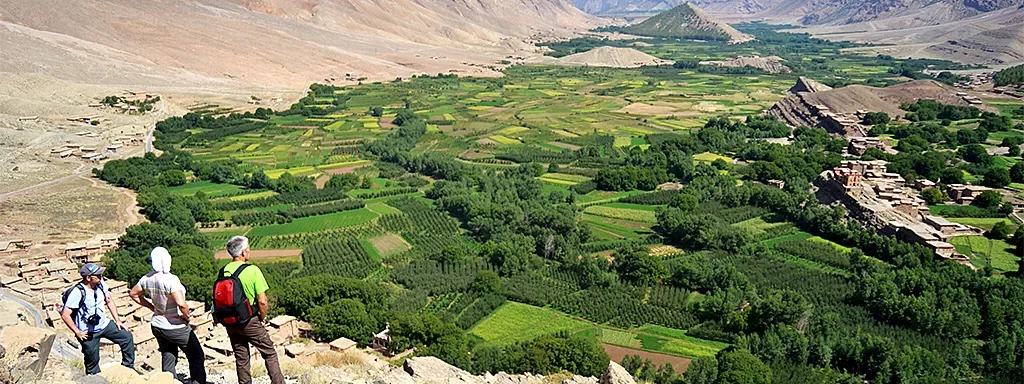
The first valley is a place of fields and settlements spread across a wider floor. After Aït Imi, the paths follow a different side of the mountains, linking villages along Ouzighimt. The river then becomes part of the walking surface, not simply scenery beside the trail. That progression gives the trek its character: broad cultivated ground, a high crossing, a river valley and the more enclosed gorge. We do not promise visits inside private homes, a particular encounter with pastoral families or flowering roses on every departure. The landscape is inhabited and worked. Ask before taking portraits, respect crops and follow the guide’s route through shared ground.
Day two is a substantial mountain stage, estimated at six and a half hours with around 1,100 metres of ascent in the source programme. Later days descend overall, but downhill does not mean effortless. Uneven riverbed footing, repeated crossings and wet footwear change the demands. The planned gorge section involves wading; it is not advertised as a swimming activity or a dry path suitable for anyone. Dates, water levels, weather and the group’s abilities must be assessed by the trekking team. Confirm footwear and the route plan before reserving, and accept that conditions may require a changed programme.
Guide, cook and mule team support the agreed traverse. Main luggage is carried where route and conditions allow, while the daypack keeps water, layers and personal essentials with you. The nights are Timit guesthouse, Tighremt n’Aït Hamed camp, Imi n’Irkt camp, Tighanimine camp and Boutaghrar guesthouse. Tents and mattresses are provided for the three camps. Sleeping bag, tent sharing, washing and toilet arrangements, drinking water and guide language need confirmation. The two guesthouse stays do not make this a hotel trek, and the two long road days need room in your wider travel plans.
From a broad valley to a river gorge
The six-day journey begins with the drive from Marrakech through Azilal to Aït Bouguemez. After a guesthouse night around Timit, the walking crosses Aït Imi and drops towards Ouzighimt. Village paths follow the river before the landscape narrows into the M’Goun gorges, where the route includes walking through water. The final stage reaches Boutaghrar and a second guesthouse night before the road return. Three nights between them are under canvas. This is a valley-and-gorge traverse, with four main walking days; it does not include an ascent of M’Goun’s high summit.
Why the route changes more than the view
The first valley is a place of fields and settlements spread across a wider floor. After Aït Imi, the paths follow a different side of the mountains, linking villages along Ouzighimt. The river then becomes part of the walking surface, not simply scenery beside the trail. That progression gives the trek its character: broad cultivated ground, a high crossing, a river valley and the more enclosed gorge. We do not promise visits inside private homes, a particular encounter with pastoral families or flowering roses on every departure. The landscape is inhabited and worked. Ask before taking portraits, respect crops and follow the guide’s route through shared ground.
The gorge stage belongs in the booking decision
Day two is a substantial mountain stage, estimated at six and a half hours with around 1,100 metres of ascent in the source programme. Later days descend overall, but downhill does not mean effortless. Uneven riverbed footing, repeated crossings and wet footwear change the demands. The planned gorge section involves wading; it is not advertised as a swimming activity or a dry path suitable for anyone. Dates, water levels, weather and the group’s abilities must be assessed by the trekking team. Confirm footwear and the route plan before reserving, and accept that conditions may require a changed programme.
A supported route with five clearly named nights
Guide, cook and mule team support the agreed traverse. Main luggage is carried where route and conditions allow, while the daypack keeps water, layers and personal essentials with you. The nights are Timit guesthouse, Tighremt n’Aït Hamed camp, Imi n’Irkt camp, Tighanimine camp and Boutaghrar guesthouse. Tents and mattresses are provided for the three camps. Sleeping bag, tent sharing, washing and toilet arrangements, drinking water and guide language need confirmation. The two guesthouse stays do not make this a hotel trek, and the two long road days need room in your wider travel plans.
Day 1 — Marrakech to Aït Bouguemez: settle into the valley
Leave Marrakech for Azilal and the mountain roads into Aït Bouguemez. The source estimates approximately six hours of travel, depending on pickup, road conditions and agreed stops. Reach the Timit area, around 1,800 metres in the programme, and settle into the first guesthouse night. If time and conditions allow, an easy orientation walk can introduce the village paths and fields. This does not imply permission to enter private homes or cultivated plots. Prepare the walking bag and discuss the next day with the team. There is no main trekking stage scheduled after the road transfer; the crossing starts tomorrow.
- Approximately 6 hours road transfer
- Via Azilal to the Timit/Aït Bouguemez area
- Orientation walk only if time and conditions allow
- Overnight: guesthouse in the Timit area
Day 2 — Aït Imi pass and the descent towards Ouzighimt
Begin from the Timit side and approach the Aït Imi climb through the Tabant/Aït Imi area. The pass is listed around 2,900 metres in the source, which uses several slightly different figures rather than one exact measurement. This is the principal sustained climb of the traverse. Allow approximately six and a half hours for the complete stage, with source estimates of around 1,100 metres of ascent and 600 metres of descent. Views depend on visibility. Continue down towards the Ouzighimt side and Tighremt n’Aït Hamed, around 2,300 metres, for the first tent night. Confirm the precise campsite and current pass conditions before departure.
- Approximately 6½ hours walking
- Aït Imi pass: about 2,900 m
- Source estimates: about +1,100 m / −600 m
- Overnight: tent camp at the Tighremt n’Aït Hamed stage
Day 3 — Along Ouzighimt to Imi n’Irkt
Follow the river valley and its village paths from the first camp towards Imi n’Irkt. The route connects settlements and cultivated ground, giving the day a different rhythm from the previous pass crossing. A lunch stop is planned in the Taghraft area before continuing downstream. The source estimates about five and a half hours of walking, with an overall descent around 500 metres. That is not a promise of a smooth path or a fixed arrival time: local footing and any water passages must be considered. Spend the second tent night in the Imi n’Irkt stage area, with the actual pitch chosen according to the operated route and conditions.
- Approximately 5½ hours walking
- Via the Ouzighimt river valley and Taghraft area
- Source estimate: about 500 m overall descent
- Overnight: tent camp in the Imi n’Irkt area
Day 4 — Through the M’Goun gorges to Tighanimine
This is the river-walking stage. The planned route crosses water repeatedly and, where the gorge narrows, continues in the river corridor. Depth, flow, weather and the group determine whether and how it can be followed. Use the footwear and equipment agreed with the guide; the image of another departure is not evidence of current conditions. A tea and lunch stop is planned near the Ifasfas source area before continuing to Tighanimine. The source gives around five hours and an overall descent estimate of 500 metres. The guide may modify or omit sections if required. The third night is in camp, with no swimming entitlement or hotel-style facilities promised.
- Approximately 5 hours in the source programme
- Repeated water passages on the planned gorge route
- Water conditions and actual routing assessed by the guide
- Overnight: tent camp in the Tighanimine stage area
Day 5 — Cultivated paths towards Boutaghrar
Leave the gorge-stage camp and continue through the lower valley’s cultivated areas and fruit-tree landscape. The walking gradually brings a different feel after the more enclosed river corridor. Lunch is planned around Tamgalouna before the onward route to Boutaghrar. The source allows approximately five and a half hours, with around 400 metres of overall descent. Particular fruit, harvests, shade or roses are seasonal rather than promised scenes. Spend the fifth night in a guesthouse or host accommodation confirmed for Boutaghrar. After three tent nights, the evening routine changes, but private bathrooms, room type and shower facilities should still be confirmed rather than assumed.
- Approximately 5½ hours walking
- Via the Tamgalouna area to Boutaghrar
- Source estimate: about 400 m overall descent
- Overnight: guesthouse/host accommodation in Boutaghrar
Day 6 — Boutaghrar to Marrakech through Ouarzazate
The return is a road day, via the Kelaat M’Gouna side, Ouarzazate and Tizi n’Tichka to Marrakech. Meal stops and the actual departure time belong in the confirmed programme. The original page provides a distance figure but no reliable full travel duration, so we do not turn it into a fixed arrival hour. Rose-related scenery along the approach does not include a festival visit or guarantee flowering fields. There is no main walking stage, sixth overnight or city guide added automatically. Confirm the drop-off and leave room for the long drive and road conditions before an onward flight or connection.
- Road return via Kelaat M’Gouna, Ouarzazate and Tizi n’Tichka
- Full transfer duration and stops to be confirmed
- No main walking stage scheduled
- End: agreed Marrakech drop-off; no sixth overnight
Duration
6 days / 5 nights; 4 main walking days
Accommodation
2 guesthouse nights + 3 tent nights
Transport
Marrakech–Aït Bouguemez transfer; Boutaghrar–Marrakech return
Who this trek suits
Experienced hill walkers seeking a valley-to-gorge traverse and simple camping
Suitability and departure dates
Prepare for consecutive hill days, a substantial first climb and river walking later in the route. A mostly descending itinerary still requires fitness and secure movement on uneven ground. Discuss experience, ability in water and any personal requirements before booking. No fixed safe water depth or universal season is advertised here. The team must confirm the route for actual conditions; additional rain or unsuitable flows can require changes. Families and shorter-stage requests need an adapted plan discussed beforehand.
Footwear, packing and camp kit
Bring hiking boots for dry stages and secure footwear suitable for wet, stony river passages as specified by the guide. Loose flip-flops are not a substitute for agreed river footwear. Pack a daypack, soft main bag, appropriate sleeping bag, warm layers, wind and rain protection, headtorch and sun protection. Protect essential belongings against water using suitable waterproof storage. Tents and mattresses are included; sleeping bag hire and any specialised equipment must be confirmed separately. Main-bag carriage depends on the route and conditions.
Meals, water and overnight facilities
The cook prepares trek meals within the agreed programme. Confirm the two road days’ meal coverage and discuss dietary needs or allergies early. Drinks are excluded: request the drinking-water arrangement, refills and bottle costs. River water used for walking is not assumed ready to drink. Camp washing, toilets, tent sharing and guesthouse rooms must be explained before reservation. The three planned camps are part of the package, not replaced automatically by village accommodation.
A proposal that includes the river stage
Send dates, party size, hiking experience, river-walking confidence and language or room needs. The quotation confirms departure format, services, transfers and the conditions-dependent gorge plan. No unsupported numeric group limit is added. Flights, Marrakech hotel nights, personal insurance and discretionary tips remain separate. Ask how a changed gorge programme would be handled if conditions do not allow the planned passage. Keep onward plans flexible until the final-day travel timing is confirmed.
Included
- Agreed Marrakech–Aït Bouguemez and Boutaghrar–Marrakech transfers
- Qualified trekking guide
- Cook and trek meals within the agreed programme
- Mule team and main luggage support where conditions allow
- Two guesthouse nights: Timit area and Boutaghrar
- Three tent nights: Tighremt n’Aït Hamed, Imi n’Irkt and Tighanimine stages
- Tents and mattresses for the three camps
Not included
- Flights
- Marrakech hotel nights and meals outside the agreed programme
- Drinks, bottled water and personal expenses
- Travel insurance and repatriation cover
- Discretionary tips for guide, mule team and driver
- Sleeping bag or specialised equipment hire unless included in writing
- Unconfirmed private visits, festivals, city guides or monument tickets
Does this trek climb the M’Goun summit?
No. It crosses Aït Imi and follows valleys and river gorges to Boutaghrar; a high-summit ascent is not included.
Are all six days walking days?
No. Days two to five are the four main walking stages. Days one and six are road transfers.
How many nights are in tents?
Three, between guesthouse nights near Timit and in Boutaghrar.
Do we have to walk through water?
The planned gorge stage includes repeated water passages and wading. Discuss ability, footwear and conditions before booking.
Is the gorge passage guaranteed for every departure?
No. Water levels, weather and the group can require changes. The guide decides the actual route.
How demanding is the Aït Imi day?
The source estimates about six and a half hours, around 1,100 metres of ascent and 600 metres of descent, with the pass around 2,900 metres.
Is swimming an included activity?
No. This is guided river walking where conditions allow, not a swimming or technical canyoning package.
Are tents, water and sleeping bags included?
Tents and mattresses are provided. Drinks are excluded; sleeping bags and any equipment hire need separate confirmation.
Will we see roses or attend the festival?
Neither flowering fields nor a festival visit is guaranteed. They depend on season and a specific agreement.
When do we reach Marrakech on day six?
The source does not give a reliable full transfer duration. Confirm the actual schedule before arranging onward travel.
Description
Quick information
- Duration 6 days / 5 nights; 4 main walking days
- Location Central High Atlas, Morocco — Aït Bouguemez, Ouzighimt, M’Goun gorges and Boutaghrar
- Difficulty Sustained mountain and river walking; suitable experience required
- Departure format Private or small group by arrangement; dates and size confirmed
Plan your trek
More information
Call us
More treks
7-Day Family Desert Trek: M’Hamid to Erg Chegaga
- 7 days / 6 nights
- Moroccan Sahara — M’Hamid, Erg Chegaga and Erg Bougarn
- Moderate desert walking; suitability assessed for each family
6-Day Morocco Desert Trek: Erg Zahar & Erg Smar
- 6 days / 5 nights · 4 walking days
- M’Hamid · Sidi Naji · Erg Zmila · Erg Zahar · Erg Smar
- Moderate desert walking
4-Day Morocco Desert Trek from Marrakech: Erg Zahar
- 4 days / 3 nights · 2 main walking stages
- M’Hamid · Sidi Naji · Erg Zahar
- Easy to moderate; fitness assessment advised
7-Day Sahara Walking Holiday: The Desert Caravan
- 7 days / 6 nights · 5 main stages + return leg
- M’Hamid · Sidi Naji · Aït Ounir · Erg Zahar · Zmila · Lanhiche
- Intermediate desert walking